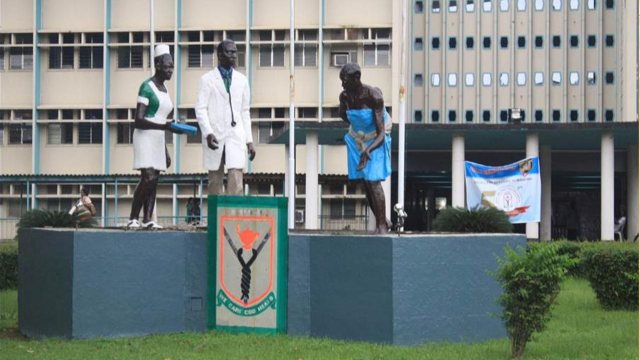
Prof. Chris Bode, LUTH Chief Medical Director, made this known in a statement issued by Prof. Wasiu Adeyemo, Chairman, Medical Advisory Committee (CMAC) of LUTH, on his behalf. According to him, a man was brought unconscious to LUTH Emergency late in the evening of Wednesday, April 2 by his friend. “Although they denied any history of recent travel, his presentation strongly suggested Covid-19. “He was handled professionally by the Infectious Diseases Consultant and his team without unduly exposing LUTH staff to danger. He died a few hours later.
“Further investigations later revealed he had earlier performed a test at Yaba soon after he travelled back to Nigeria from Holland and the test was positive. “He was a known diabetic hypertensive patient. He also had a kidney transplant for chronic kidney disease and was on immunosuppressant drugs. “The corpse has since been handed over to the appropriate Unit of the Lagos State Ministry of Health for safe burial according to international best practices. “Our Department of Community Medicine has moved swiftly to trace, follow-up and assist gallant staff who managed the patient,” Bode said. He said that LUTH management implored all members of staff to continue observing strict standard protocols while handling all patients as medical personnel are especially at increased risk from such undisclosed exposure.
“All efforts are being made to ensure the availability of all required items to continue the effective management of such cases that come to LUTH. “Efforts are also in top gear to complete the isolation facility in LUTH for management of any possible spillover from the Yaba Infectious Disease Hospital (IDH) if the surge in patients’ load continues,” Bode said.
Zeynab Abib is known for her RnB and afrobeats hits but she is also passionate about traditional music and has recorded songs in the Bolodjo style.
She comes from an area of Benin close to the Nigerian border which shares Yoruba culture.
“There are so many beautiful things [in Yoruba culture], the way to dress, the way to eat, the way to dance, the music, the talking drum, everything. There’s nothing money can buy like being proud of where you come from,” she told This Is Africa.
“For me it’s a big, big honour to represent that culture,” Zeynab added.
Her grandmother was a famous traditional singer, but Zeynab, who grew up in Ivory Coast, only discovered this when she returned to Benin when she was 18.
It was then that everything made sense, she was destined to be a singer and carry on in her grandmother’s footsteps.
Since then, Zeynab has performed and worked with an impressive list of bands and artists, including Congolese Awilo Longomba, and she has been a winner at both the Kora and Afrima music awards.
One of my favourites songs of hers is No Go Die. It’s an African take on Gloria Gaynor’s defiant and famous anthem I Will Survive.
As Zeynab says: “When you love somebody a lot and that person is leaving you, what can you do? What can you do? [In this song] I want to show that person that I’m not suffering… even if it’s not true!”
The interview will air on 4 April on BBC World Service and is available online after the broadcast.
More than 4,300 people have died in the UK after testing positive for coronavirus. Among them are frontline medical staff. Sirin Kale tells the story of two of them.
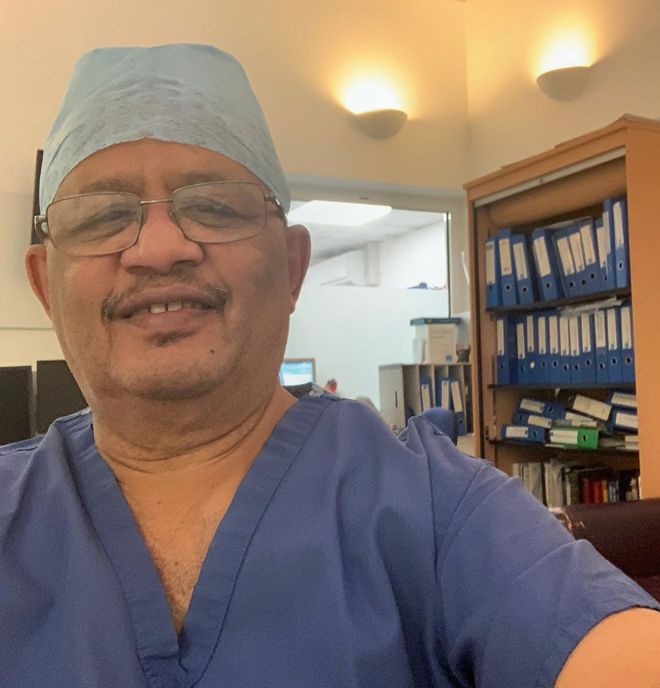
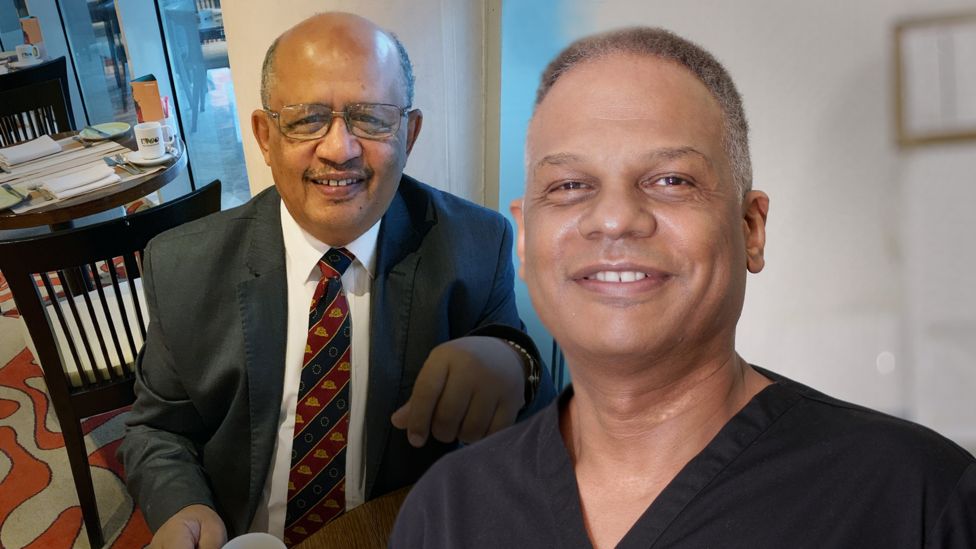
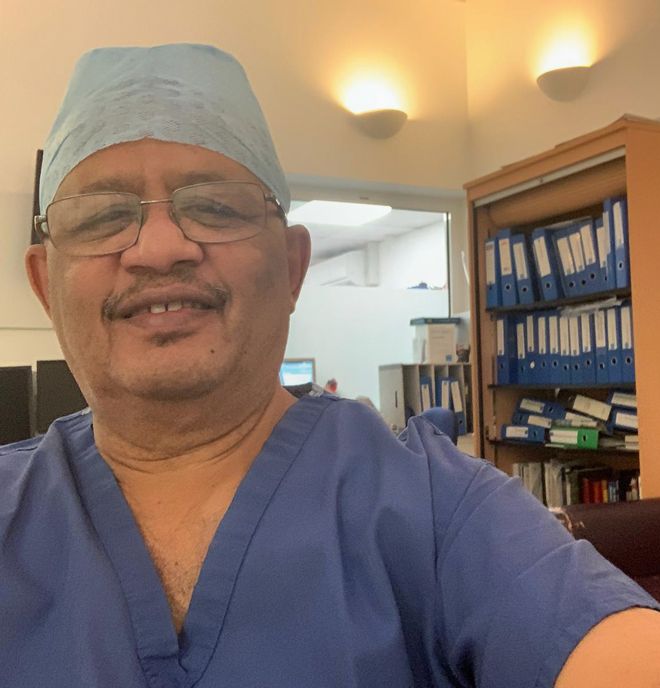
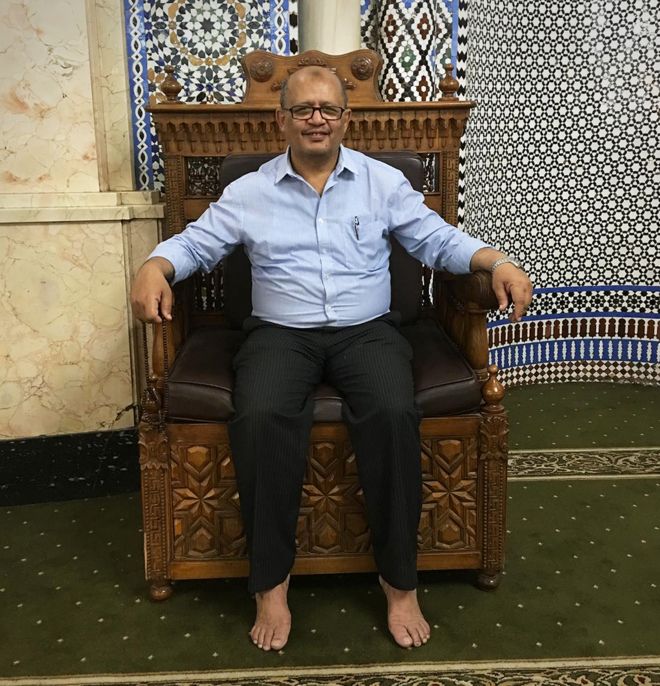
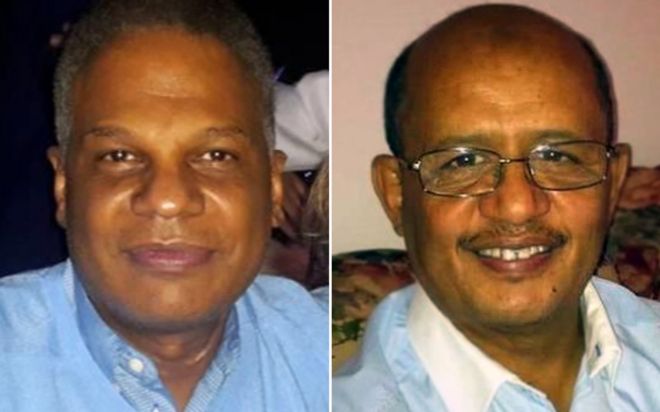
The two men did not know each other, probably their paths never crossed, but in death they would find a strange symmetry. Dr Amged El-Hawrani and Dr Adil El Tayar – two British-Sudanese doctors – became the first working medics to die of coronavirus in the UK.
Their families don’t want them to be remembered in this way – but rather as family men, who loved medicine, helping their community, and their heritage.
Like the many men and women who come from overseas to join the NHS, El-Hawrani, 55, and El Tayar, 64, left behind friends and relatives back home to dedicate their careers to the UK’s health service. They married and had children – El-Hawrani settling in Burton-Upon-Trent; El Tayar in Isleworth, London. And they became pillars of their communities, while maintaining ties to the country of their birth, the Sudan that both men loved.
Their stories are illustrative of the many foreign-born medics who even now are battling Covid-19.
EL TAYAR FAMILY
Adil El Tayar was born in Atbara in northeast Sudan in 1956, the second of 12 children. His father was a clerk in a government office; his mother had her hands full raising her brood. Atbara was a railway town, built by the British to serve the line between Port Sudan on the Red Sea coast, and Wadi Halfa in the north. It is a close-knit community, where the first Sudanese labour movement started, in 1948. Everyone knows everyone.
“He came from humble beginnings,” says Adil’s cousin, Dr Hisham El Khidir. “Whatever came into that household had to be divided amongst 12 kids. It’s the reason he was so disciplined when he grew up.”
EL TAYAR FAMILY
In Sudan in the 1950s and 1960s, bright young men became doctors or engineers – respected professions that would give their entire family a better life. And when you’re one of 12 children – well, that’s a lot of people to help look after. Adil knew this, which is why he was a diligent student, even from a young age. But he didn’t mind, in Sudanese culture, looking after your family isn’t seen as a burden. It’s just what you do.
“He was always so serious, so focused,” Hisham remembers. “He wanted to do medicine early on, because it was a good career in a third-world country.” He had a calm, caring disposition. “Never in the years I knew him, did I ever hear him raise his voice.” Hisham looked up to Adil, who was eight years older than him, and later followed in his footsteps to become a doctor.
The El-Hawrani family lived almost 350km (217 miles) away, down the single-track railroad that links Atbara to the capital Khartoum. It was there that Amged was born in 1964, the second of six boys. His father Salah was a doctor, and in 1975 the family moved to Taunton, Somerset, before settling in Bristol four years later.
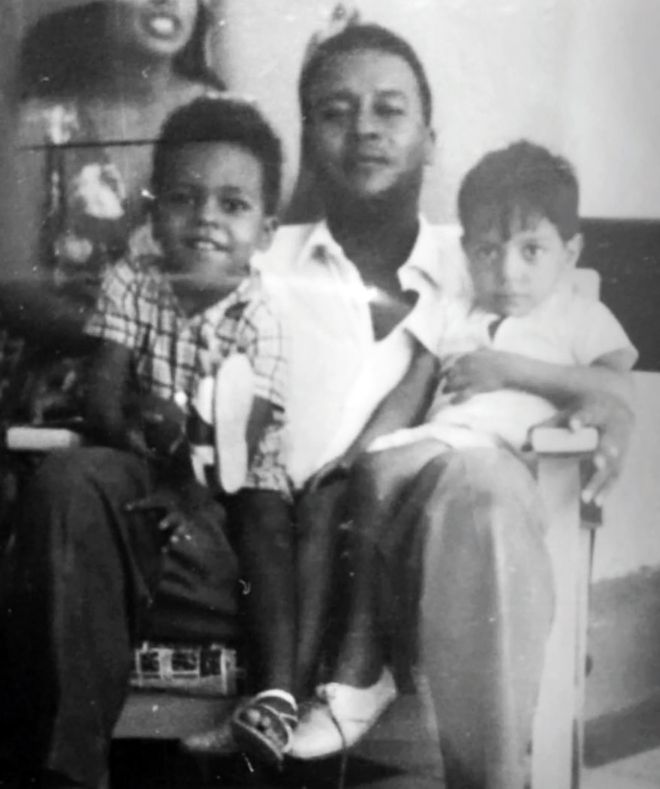
Amged El-Hawrani (left) as a child – with father Salah and older brother Ashraf
“Dad was one of the first waves of people coming over from Sudan in the 1970s,” remembers Amged’s younger brother, Amal. “We didn’t know any other Sudanese families growing up in the UK. It was just us and English people. It felt like an adventure. Everything was new and different.”
Only a year apart in age, Amged and his older brother Ashraf were inseparable. “They both could have done anything,” says Amal. “They were intelligent, they were all-rounders. They loved football and technology. They embraced everything – just drank it all in.”
Amged loved gadgets. “He’d always turn up with this bit of kit he’d just bought,” Amal laughs, “saying, ‘Look, I’ve just bought this projector that can fit in your pocket, let’s watch a film!'”
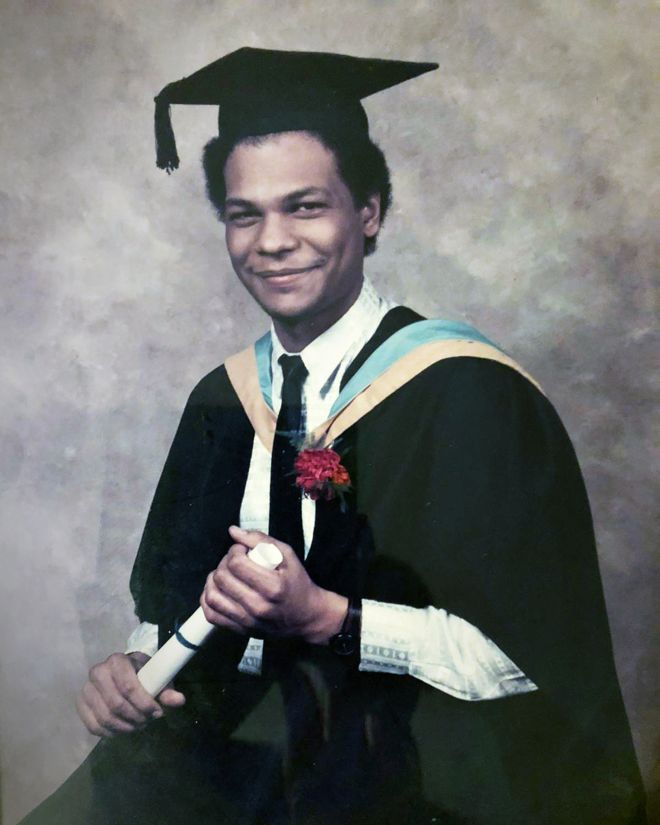
Amged El-Hawrani’s graduation photo from the Royal College of Surgeons in 1993
Amged and Ashraf both studied medicine, like their father. And then in 1992, tragedy struck – Ashraf died of an asthma attack, aged 29. It was Amged who discovered his body.
“It had a huge emotional impact on him,” Amal says. “But he became the rock of the family.” He even named his son Ashraf, after his brother.
Over the coming decades, Adil and Amged forged careers in the NHS. Adil become an organ transplant specialist, while Amged specialised in ear, nose, and throat surgery.
The life of an NHS doctor isn’t easy – it is high-stakes work, which often takes you away from your family.
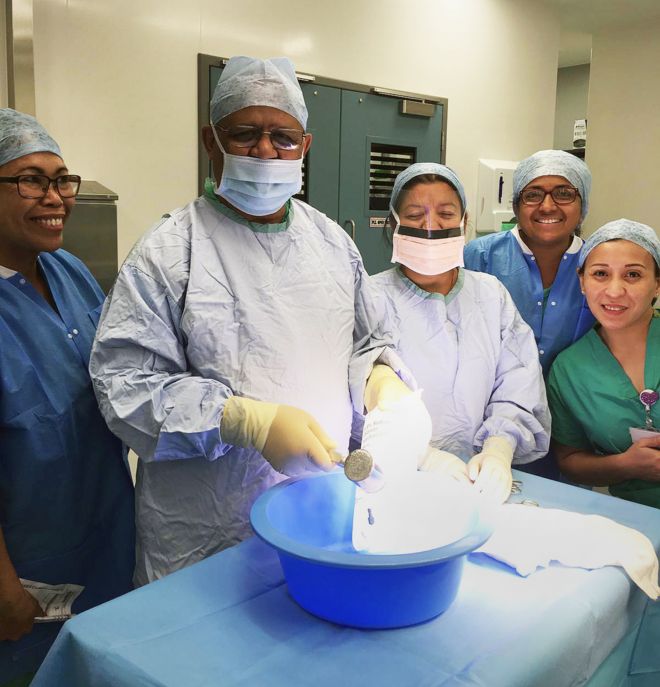
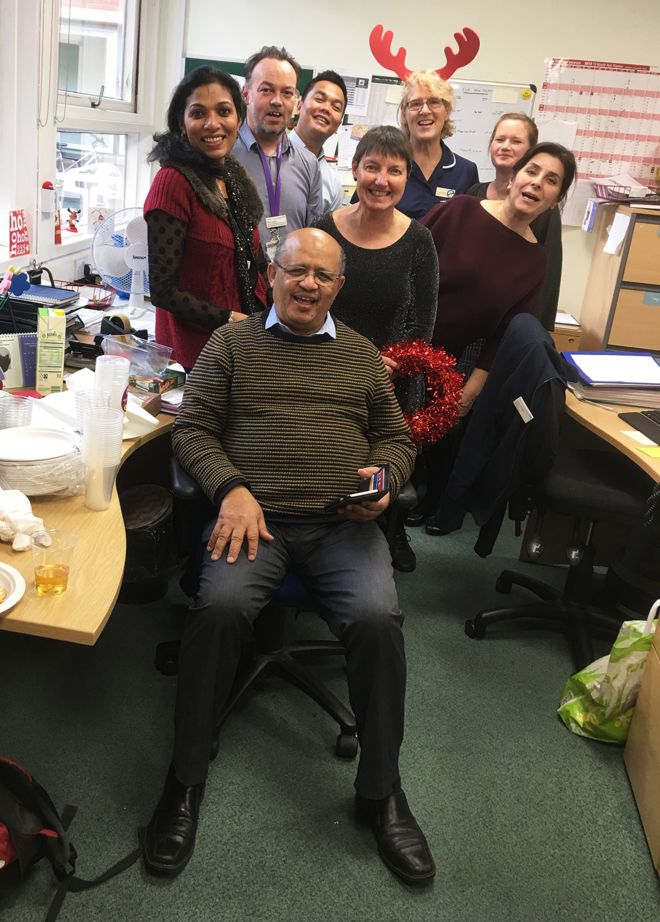
Adil El Tayar with colleagues
But Adil’s children always felt that he had time for them. “No matter how tired he was, he would always get home from work and make sure he spent time with each of us,” says his daughter Ula, 21. “He cared about family life so much.”
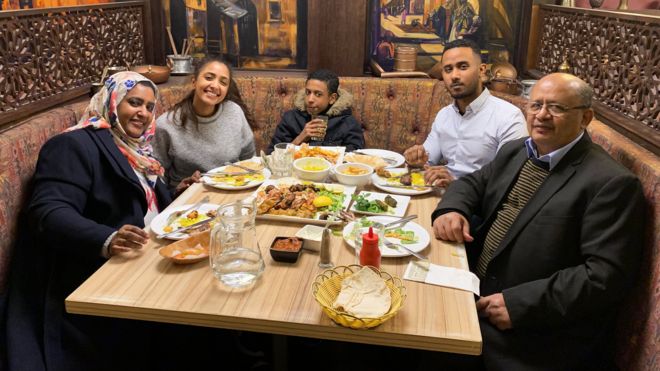
Adil El Tayar with members of his family
Adil loved to potter about in his garden, tending to his apple and pear trees, and planting flowers all around. “It was his happy place,” says Ula. He also loved to collect new friends. “He’d have barbecues in summer, and there would often be some random person there you’d never met before,” Adil’s son Osman, 30, jokes. “You’d wonder where he’d picked them up from.”
Amged was intellectually curious, and a great conversationalist. “He was one of those people who had an encyclopedic knowledge of everything,” says his brother Amal. He was also a Formula One fan – Ayrton Senna was his legend. “Amged was generous, and without guile,” remembers his friend Dr Simba Oliver Matondo. They met when they took the same class at university, and spent their student years eating Pizza Hut food – a big treat back then – and watching Kung Fu films.
The National Health is staffed by many foreign-born workers – 13.1% of NHS staff say their nationality is not British, and one-in-five come from minority backgrounds.
As of 3 April, four British doctors, and two nurses, have died after testing positive for COVID-19. Five were from BAME [Black, Asian and minority ethnic] communities. In addition to Adil and Amged, there is Dr Alfa Sa’adu, born in Nigeria, Dr Habib Zaidi, born in Pakistan, and nurse Areema Nasreen, who had Pakistani heritage. “We mourn the passing of our colleagues in the fight against Covid-19,” says Dr Salman Waqar of the British Islamic Medical Association. “They enriched our country. Without them, we would not have an NHS.”
‘NHS crown’
Nurse Aimee O’Rourke, 39, died after a Covid-19 diagnosis on Thursday 2 April.
On Facebook, her daughter Megan Murphy wrote: “You are an angel and you will wear your NHS crown forever more because you earned that crown the very first day you started.”
O’Rourke was treated at the Queen Elizabeth The Queen Mother Hospital in Margate, Kent, where she worked.
Both Adil and Amged considered themselves British. “Amged was in this country for 40 years,” says Amal. “He was as British as tea and crumpets.” But they kept close ties with their native Sudan. “When someone emigrates to the UK, they don’t just cut all their ties with their country,” Adil’s cousin Hisham explains. “They make a better life for themselves, but they maintain their roots.”
Adil returned to Khartoum in 2010, to set up an organ transplant unit. “He wanted to give something back to the less fortunate in Sudan,” his son Osman explains. Since Adil’s death, his family has received dozens of phone calls from people in Sudan, telling them about their father’s charity work. They knew their dad spent a lot of time helping people back home in Sudan – they’d overhear his phone calls.
But none of Adil’s children realised just how many people he’d helped, until after he died.
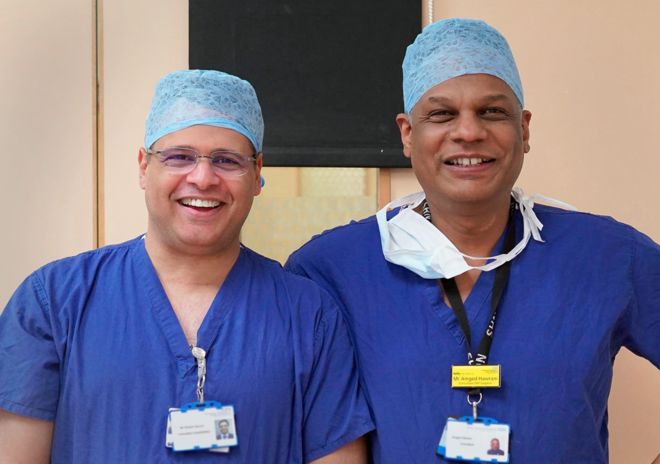
Amged El-Hawrani (right) with a colleague
Amged was also charitable, climbing in the Himalayas in 2010 to raise money for a CT scanner for Queen’s Hospital Burton, where he worked. Like Adil, he was connected to his heritage. “He’d always reminisce about growing up in Sudan,” says his brother Amal. “He was very proud to be Sudanese.”
His friend Matondo was a frequent visitor at Amged’s mum’s house in Bristol, where they’d eat “ful medames”, a traditional fava bean stew, and feta cheese with chillies. A supporter of Al Merrikh – the Manchester United of Sudan – Amged arranged for the Khartoum team’s dilapidated pitch to be repainted, picking up the bill himself.
Both doctors cared deeply about the NHS, an institution they had spent their lifetimes serving. “Adil really believed in this excellent system that provided free care at the point of delivery to everyone who needed it,” says his cousin Dr Hisham El Khidir.
His passion rubbed off on his children – Osman and his sister Abeer, 26, both followed in Adil’s footsteps to become doctors. The day Osman was accepted as a surgical registrar – a prestigious, competitive post – Adil was emotional. “He was so happy,” Osman remembers. “He just kept saying, ‘Mashallah, mashallah.'”
When both doctors got sick, they didn’t think much of it, their families say. Amged was the first to fall ill. His mother had recently recovered from a nasty bout of pneumonia, and in late February, after finishing a long shift, he drove to Bristol to see her. Amged felt unwell in the car, but assumed he was probably just exhausted.
By 4 March, he was admitted to Burton’s Queen’s Hospital. His colleagues put him on a ventilator. He was later transferred to Glenfield Hospital in Leicester, where he was put on a more sophisticated ECMO machine, to breathe for him. Amged would stay on that machine, fighting for his life, for nearly three weeks.
Meanwhile, Adil was working in the A&E department of Hereford County Hospital. On the 13 March, the first UK death from coronavirus was reported in Scotland. The very next day, Adil started feeling unwell. He came back to the family house in London, and self-isolated.
Over the next few days, his condition deteriorated. On the 20 March, Abeer didn’t like how her dad looked – he was breathless, and couldn’t string a sentence together – and she called an ambulance. Doctors at West Middlesex University Hospital put Adil on a ventilator. But even then, alarm bells weren’t ringing. “We thought, this is bad,” says Osman. “But we had no idea it would be fatal.”
On 25 March, Adil’s family received a call from the hospital. Things were very bad, and they should come now. They raced there to be with him. Adil’s children watched their father die through a glass window. They weren’t allowed in the room, because of the risk of contagion.
“That was the most difficult thing,” says Osman. “Having to watch him. I always knew that one day my father would die. But I thought I would be there, holding his hand. I never imagined I would be looking at him through a window, on a ventilator.”
Adil spent decades serving the NHS. But his family feels that the NHS didn’t do enough for him in return, by giving him the protective gear that might have prevented him contracting coronavirus. “I think it’s unbelievable in the UK in 2020 that we’re battling a life-threatening disease, and our frontline staff are not being safely equipped with PPE to do their job,” says Osman. “Bottom line is that it’s wrong and it needs to be addressed immediately.”
Amid repeated claims of shortages in some parts of the NHS, the government has offered frequent bulletins on the volume of personal protective equipment being delivered. The Health Secretary Matt Hancock has said he will “stop at nothing” to protect frontline health workers – describing the situation as “one of the biggest logistical challenges of peacetime”.
All the time Adil had been in hospital, Amged had clung onto life. But on the 28 March, doctors decided to take Amged off the ECMO machine. Dressed in protective gear, Amged’s brother Akmal was allowed into his room, to hold his hand. Amal watched from behind a window.
Amged will be buried in Bristol, beside his dad, and close enough for his mum to visit.
EL-HAWRANI AND EL TAYAR FAMILIES
At his own request, Adil will be buried in Sudan, besides his father and grandfather. Getting the repatriation paperwork sorted is proving difficult, given the coronavirus lockdown. “The last wishes of someone who died are very sacred in our culture,” explains Osman. “We will make it happen.”
Adil’s children won’t be able to attend the funeral – although cargo planes are flying, there are currently no passenger flights to Sudan. But he won’t be buried alone. The community of people Adil grew up with – his siblings, and their children, and the people he supported over the years, will bury him instead. In Sudanese tradition, every mourner digs their hand into the dust, and throws soil into the grave. “There are hundreds of people waiting to bury him,” says Osman. “I’ve been on the phone with them all. They’re waiting for him to arrive.”
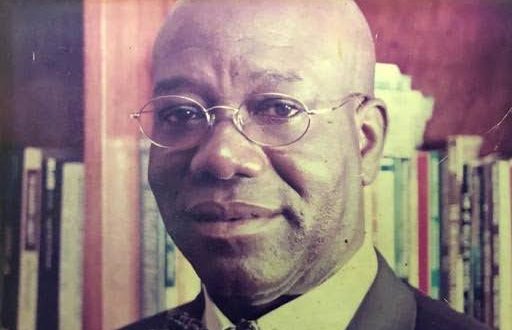
Former director-general of the Nigeria Law School Dr Kole Abayomi has died in the United Kingdom (UK) after contracting coronavirus.
Abayomi died on Thursday, April 3, a statement by the secretary of the Body of Senior Advocates of Nigeria (BOSAN), Seyi Sowemimo, SAN, disclosed.
“The BOSAN Secretariat wishes to announce the death of Dr Koleade A. Abayomi SAN, OON, who died in the early hours of today, 2nd of April, 2020 in London,” Sowemimo said.
“We deeply mourn the sad loss of our departed colleague and pray that the Almighty God grant his family the fortitude to bear the loss.”
Abayomi was born on the 20th of August, 1940. He was called to the Nigerian Bar in 1966 and admitted to the Inner Bar in 2005. He taught at the Nigerian Law School and rose to the position of Director-General in November 2004.
“He retired in 2005 and went into private practice and consultancy in Lagos until his death. He’s survived by his wife, children and great-grandchildren,” Sowemimo said.
One of his colleagues Dele Adesina SAN said Abayomi held the ideals, values and virtues of the Legal Profession exceedingly high.
“Dr Kole Abayomi SAN built his reputation on what was all the way positive such as proud parentage, sound legal education, high standard of legal practice, elegance, decorum and self-confidence. These qualities will remain indelible in our hearts,” Adesina said in a separate statement.
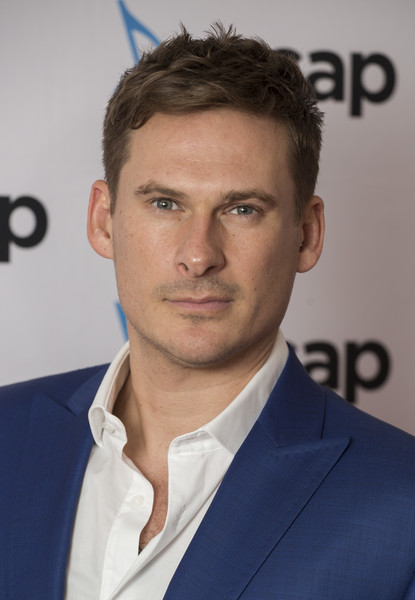
Lee Ryan is sticking to his guns after claiming the devil controls the UK government in a confusing social media post
The Blue singer shared an image on Instagram of a hand being injected by a hand wearing a latex glove, and an X-ray of a hand with a microchip inside.
The 36-year-old added the caption: ‘This is the mark of the beast – 666 – this will be the next step of governments world wide.
‘Sorry to post this s**t but it’s true. I just wanna spread the word so people know the truth of what’s coming…’
He went on to share a quote that claimed the human race is ‘being indoctrinated to be dependent and subservient to the system’.
The Celebrity Big Brother star had previously shared a post about 5G mobile networks, which conspiracy theorists believe is connected to the coronavirus pandemic.
He reiterated his point on his Instagram Stories, writing; ‘5g…that’s all I’m saying (sic).’
Lee explained that he is standing by his earlier posts and posted a screengrab of news stories about what he said.
‘Funny how they don’t mention 5g…and I’m not going to apologise for my religious beliefs…. god bless you all – amen,’ he wrote.
Nigerian veteran singer, Salawa Abeni has raised an alarm after being blackmailed with her old “nude photos”.
Salawa who shared screenshots of her chats with the blackmailer, revealed that the man who identified himself as Jason and a resident of Osun state is threatening to tarnish her image and destroy her career of over 45 years.
She wrote as she shared the “nude photos” in which she suffered a nip-slip;
Good morning my Family, friends and Fans. I have something very important to tell you and I will really appreciate your audience. I am very disappointed that someone somewhere will try to tarnish my image and threaten to destroy my career of over 45 years. This morning, I received messages from somebody threatening to expose very old pictures of me and in the process, blackmailing me for money.
These could’ve been pictures of me in the hospital or even with my partner, but is this what has become of us?? I plead with everybody out there to be very careful as our current situation has made people very desperate. I am almost 60 years old, I have worked very hard and made a name for myself for somebody to believe that they can threaten and trample on my feelings, this is very sad.
So I have decided to share the messages and pictures sent by this person with everyone for you all to see! Thank you and God bless you! For you the blackmailer, I refuse to be bullied by you as I’m sure that I’m old enough to be your MOTHER!!
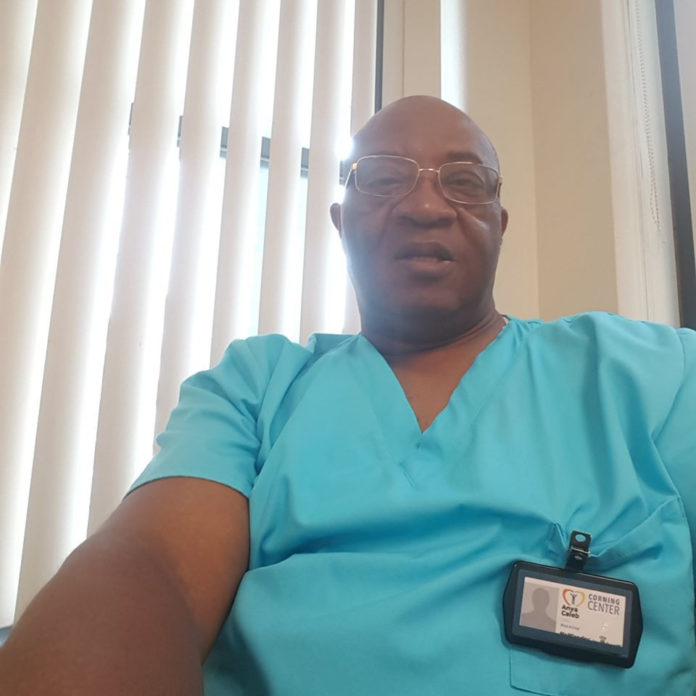
A Nigerian doctor identified as Apostle Caleb Anya, has died of Coronavirus in the United States.
The deceased who has been working hard to give treatment to those infected with the virus, died 5 days after he was admitted in a New York hospital for contracting for the virus.
Nigerian doctor dies from Coronavirus in US, to be cremated
Apostle Caleb who is from Ohafia in Abia state, will be cremated in line with the directive for for management of Coronavirus patients. He has been described as a “hero” by his close relatives.
Kourtney Kardashian appears to have revealed that she’s quit Keeping Up with the Kardashians, after a recently aired episode saw her get into a shock fight with sister Kim Kardashian-West.
Fans of the hit show were left gobsmacked by its season 18 opener, when Kim accused Kourtney of not putting in any effort when it came to filming. As tensions between the pair rose, they started scratching at one another before the former started kicking and and slapping Kourtney and fellow sister Khloe was forced to try and break up the brawl.
Viewers soon to social media to pick a side. But when one Twitter user wrote, “[Kourtney Kardashian] just needs to quit the damn show! I’m over her not wanting to film,” the reality star quote-tweeted and said: “I did. Bye.”
“Does anyone apologize or correct their tone or words when they’re being mean to Kourt? Cause I’m not seeing that,” another wrote, to which Kourtney replied: “Never. They actually don’t see where my hurt comes from.”
When another fan praised her for being brave enough to make the decision Kourtney explained herself.
She said: “Took a lot to get there but choose happiness always. It’s easy to forget what really matters.
“It’s been years of build up.”
Since then Kourtney has been posting on her Instagram stories, not saying anything else about her decision to go.
The fight between Kim and Kourtney is one of the most explosive in KUWTK history.
It started when Kim questioned her older sister’s work ethic which saw Kourt hit the roof, saying: “I will literally f*** you up if you mention it again. Shut the f*** up and don’t laugh like that, you look like a freak!”
Kim thew punches and Kourtney dug her nails in to her back as Khloe Kardashian attempted to break them up.
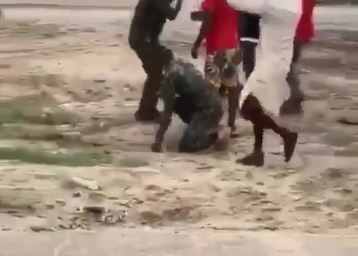
Two Nigerian soldiers have threatened to rape the mothers of the youths in Warri, Delta state who allegedly killed one of their colleagues yesterday April 2.
Recall that during the enforcement of the lockdown exercise in the state on Thursay April 2, youths in Ugbuwangue community in Warri, Delta state had a clash with some soldiers after a youth leader identified as Jospeh Pessu, was allegedly shot dead by a soldier.
The youths pursued the soldiers and attacked them physically. Unconfirmed reports claim that one of the soldiers died during the face-off.
Two aggrieved members of the Army made a video, threatening to sexually abuse the mothers, wives and daughters of the youths that allegedly killed their colleague. They threatened to infect the girls and women with HIV.
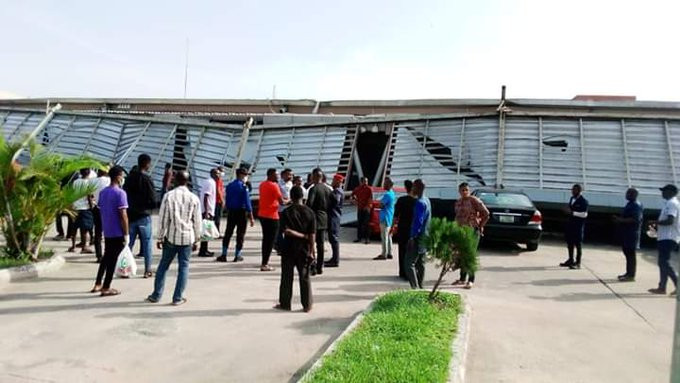
Tragedy was averted on Thursday afternoon when a massive billboard allegedly belonging to Spar shopping mall fell and damaged 13 vehicles belonging to its customers.
The incident happened at 3pm on Thursday, according to the mall manager, Mrs Kemi Daniel, who added that the collapse was with a terrifying bang, which sent thousands of customers scampering for safety.
The signboard placed atop the roof of the massive mall fell on the vehicles, blocking the exit section of the mall.
Mrs Daniel said they were still investigating what would have caused the signage to collapse suddenly, adding that they have pacified the affected customers by assuring them that they will repair the 12 vehicles, just as one was not fatally damaged.
“We are grateful to God that nobody, none of our esteemed customers was killed or injured. We are picking the bills for the overall repairs of the affected 12 vehicles.
“We have also assured the owners of the vehicles that we shall provide mobility for them throughout the period their vehicle would be under repair. “We shall look at issue of compensations to the affected persons but they should give us time,” she said.
One of the customers, who spoke to Daily Trust, said he might sue them for lack of safety measures.
Meanwhile the management and owners of the Calabar Mall and SPAR in a statement it issued Thursday evening, stated that the External Advertisement Board located by the parking of the mall collapsed, possibly due to heavy winds, stressing that nobody was hurt in the incident, but unfortunately a few vehicles were damaged.
It explained that “the collapse of the billboard happened in the evening of April 2, 2020, as a Safety Conscious organization, we have hitherto ensured that the entire mall is built to leading standards. The External billboard collapsed and thankfully, nobody was hurt.”
“As an organization, we will want to reiterate that the mall is installed with the best safety measure and our safety equipment are top-notch because the safety of all of our tenants and shoppers is of utmost importance to us.”
The statement added that, “the Calabar Mall and SPAR supermarket remain open to customers and is safe, and we continue to do our best to ensure that our stores are well-stocked to meet our customers’ demands”.