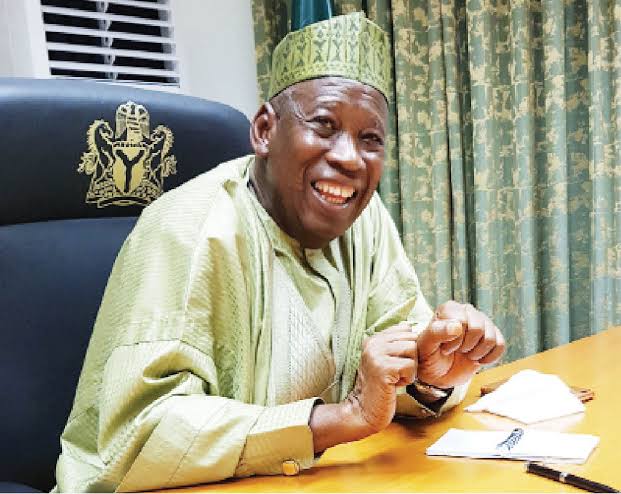
The Supreme Court has dismissed the appeal by Abba Kabiru-Yusuf challenging the election of Governor Abdullahi Umar Ganduje in the March 9, 2019 governorship election.
In a unanimous judgment by a five-member panel led by Justice Sylvester Ngwuta, the apex court held that Kabiru-Yusuf had not demonstrated that the concurrent judgments of the tribunal and Court of Appeal were perverse.
The court, therefore, dismissed the appeal, including the cross appeal for lacking in merit. Others members of the panel are: Justices Kudirat Kekekere-Ekun, Olukayode Ariwoola, Amina Augie and Uwani Abba-Aji.
Recall that the Chief Justice of Nigeria, Justice Tanko Muhammad was absent when the Supreme Court commenced its judgement in the governorship appeal on Kano State. In his place, Justice Sylvester Ngwuta led the five-member panel of justices.
Adegboyega Awomolo (SAN) who is counsel to PDP candidate in Kano, Abba Kabiru-Yusuf alias Abba Gida-Gida, had asked the Supreme Court to overturn the decisions of the Court of Appeal and the governorship election petition tribunal and affirm his client as winner of the March 9, 2019 election.
He said the INEC Returning Officer illegally cancelled election results from 207 polling units in the state, declared the election inconclusive and went ahead to fix March 23, 2019, for a supplementary poll. Awomolo asked the court to hold that the second election was no longer material as Kabiru-Yusuf was already leading in the main election.
But INEC counsel Ahmed Raji (SAN) asked the panel to dismiss the appeal for want of evidence to prove that the 207 polling units were cancelled by the Returning Officer. He said different reports showed that PDP agents and thugs prevented the Returning Officer from collating the results and carted them away.
Also, Governor Ganduje through his lawyers, Offiong Offiong (SAN) and M.N. Duru, argued that the submissions by Kabiru-Yusuf and PDP were based on wrong premises which did not take cognizance of the attack on the Returning Officer.
They, therefore, asked the apex court to dismiss the appeal and affirm their victory in the election.
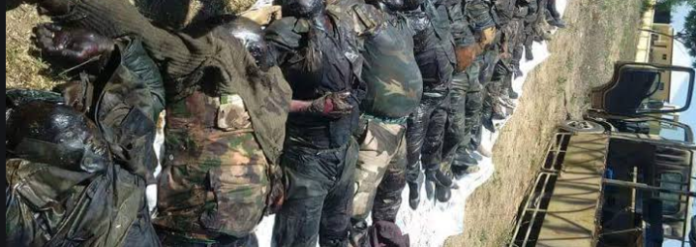
No fewer than 17 soldiers were killed, while many others were abducted in two confrontations on Friday and Saturday between the military and Boko Haram insurgents on Bama-Gwoza highway.
It was, however, gathered that the number of casualties on the Boko Haram side were high, although it could not be ascertained as of press time.
The insurgents were said to have initially attacked Firgi, 20 kilometres north of Pulka along the road from Gwoza to Bama on Friday.
They were said to have killed 13 soldiers in the crossfire that took over two hours.
The insurgents were said to have forced some of the soldiers to retreat.
Sources added that the insurgents carted away some arms, ammunition and vehicles belonging to the Nigerian Army.
One of the sources said, “During the crossfire started around 10pm, 13 soldiers were killed with four of their vehicles taken away.
“On Saturday, the insurgents came back to the same area to continue from where they left.”
They were said to have attacked a military company at Banki junction on Bama-Gwoza Road around 10pm.
The battle was said to have lasted for about three hours.
Our correspondent gathered that the casualties on the side of the military were four, while that of the insurgents was not known.
The insurgents were also said to have abducted some soldiers and carted away arms and ammunition.
Reaction of the military could not be got as text messages to both Col. Sagir Musa, Army spokesman, and Col. Isa Ado, spokesman for the Military Joint Task Force on Counter-Insurgency in the North-East (Operation Lafiya Dole) were not responded to.
Meanwhile, the head of the counter-insurgency operation in the North-East, Maj. Gen. Olusegun Adeniyi, said Boko Haram had failed in the ongoing war against the country.
Speaking at a party organised for the troops in Maiduguri on Saturday, Adeniyi who led a victory dance, said, “Boko Haram has failed, we are not going to let them get an inch of land in Borno, Adamawa and Yobe states.”
Adeniyi, who called out officers and soldiers and guests at the get together to be part of the victory dance, said, “We are happy to dance and shame Boko Haram who do not want us to be happy.”
The Army Chief, who was joined in the dance by the Borno Deputy Governor, Alhaji Usman Kadafur, said, “I have made a covenant to go after Boko Haram, fight Boko Haram and end their menace.”
In his speech, Kadafur said, “We appreciate all the efforts by the military to safeguard our territory. We pray to God for guidance and repose of the souls of those that have paid the supreme price and we asked that God continue to be with their widows and orphans.”
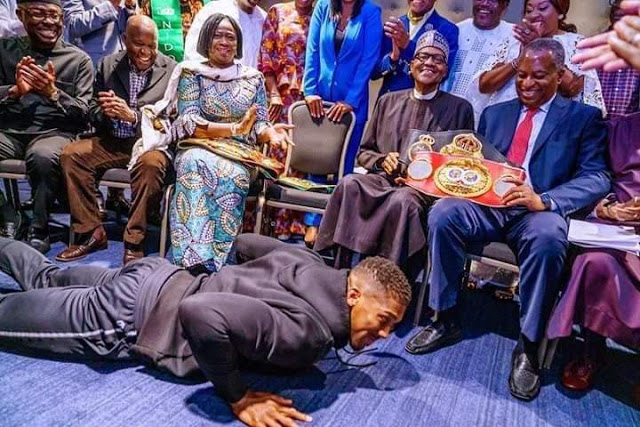
World Heavyweight Champion Anthony Joshua greets President Buhari in London showing humility and good up bringing. Welldone champ as you show respect for elders.That’s Yoruba culture in display.
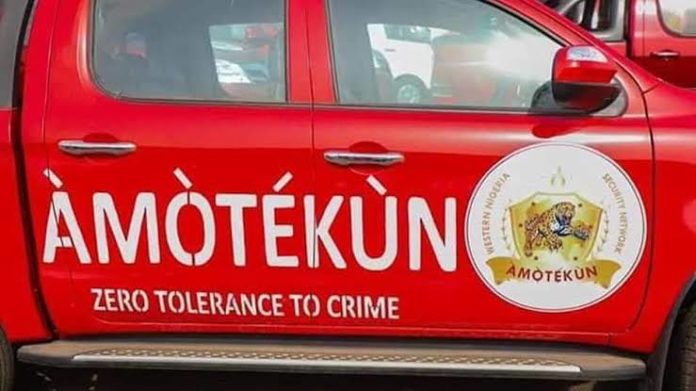
Former Minister of Aviation Femi Fani-Kayode has warned President Muhammadu Buhari against arresting Yoruba leaders over the establishment of a security outfit for the South-west, code name Operation Amotekun.
Naija News had reported that Miyetti Allah Kautal Hore had asked Buhari over the promotion of Amotekun.
This call was made by the President-General of the group, the umbrella body of Herdsmen, Bello Abdullahi Bodejo, during an interview with The Sun.
Bodejo stated that banning Amotekun was not enough, adding that arresting its leaders would be ideal.
While describing the South-west as Fulanis God-given areas, claimed that Amotekun was a ploy to stop herdsmen from the South-west.
He added, “I read it on the internet. However, it would have been a good development, if the national security agencies – the Army, the Police, the DSS, the Civil Defence, etc, were not living up to expectations.
“Will Amotekun have more security intelligence than these national security organizations The answer is no.
“Anything security should be left with those security organisations, so, I don’t know the reason for this one from the Southwest, except that it has sinister motive.
“Look at how the vigilantes are causing troubles all over; there is what is called interest in setting up this type of thing. Look at Zamfara where the vigilantes and the Fulani are having issues.
“They should not only ban it, but should arrest the leaders of this group. Like I said earlier, nobody or group has more security intelligence than the Police. The Army is doing enough; the DSS is also doing enough, likewise the Civil Defence.”
Reacting in a post on his Twitter handle, Femi Fani-Kayode dared the federal government to arrest south-west leaders.
According to the Peoples Democratic Party (PDP) chieftain, Yoruba leaders were ready to sacrifice all for the freedom of their loved ones.
He wrote: “Go ahead, arrest us and ignite a fire. Do your worst and make heroes and martyrs out of us. We are ready to sacrifice ALL for the freedom of our loved ones & children & for the future generations of our people.
“The struggle for secession in 1967, the Nzeogwu coup of Jan. 15th 1966 and the Orkar coup of April 22 1990, which all aimed at breaking the Islamic North’s political stranglehold coupled with the centrifugal ethnic nationalism of today, have all been abundantly vindicated.
“There is no realistic prospect of working, in equal partnership, with the Islamic North towards any shared enlightened vision of the future. It is time for us to go our separate ways.
“In as much as the control of one’s own destiny is the pre-condition for progress, a conflict with the Islamic North is inevitable if the South truly desires to successfully reform itself.”
There was pandemonium at the Sheikh Abubakar Gumi Central Market, Kaduna, on Thursday as a yet-to-be-identified soldier allegedly stabbed a shoe seller to death.
The soldier, according to an eyewitness, narrowly escaped being lynched.
He was, however, beaten up by traders in the market.
The incident was said to have created confusion as many ran helter-skelter.
The state Police Public Relations Officer, DSP Yakubu Sabo, confirmed the incident to our correspondent on the phone.
Sabo said the incident involved four soldiers, three of whom were at large.
He identified the slain trader as Yusuf.
An eyewitness, who simply identified himself as Lawal, said trouble started when the deceased trader approached the soldiers to advertise his shoes.
He said no one could say what transpired between the soldiers and the trader, as one of the soldiers pulled out a jackknife and stabbed the victim on his stomach.
“Immediately other traders saw what happened, they pursued and held the one that stabbed the boy and beat him thoroughly,” Lawal said.
The Secretary of the Sheikh Gumi Central Market Union, Alhaji Aliyu Shuaibu(Fancy), who also confirmed the incident, said the soldier was rescued and taken to an undisclosed hospital in the metropolis.
READ ALSO: Ebonyi nursing mother’s corpse found in gutter
He said immediately the incident occurred, market officials, not wanting the incident to escalate, put a call to security officials, including the state Commissioner for Internal Security and Home Affairs, Mr. Samuel Aruwan.
The police spokesman said the soldier at the centre of the incident was brought in unconscious and that he was being treated while investigation was ongoing.
Sabo said, “There was such an incident today(Thursday) involving a group of four soldiers. The soldiers had a misunderstanding with a trader called Yusuf at the Sheikh Abubakar Gumi Central Market which resulted in one of the soldiers removing his jackknife and stabbing the said Yusuf.
“He(Yusuf) was rushed to the Yusuf Dantsoho Specialist Hospital but later confirmed dead. One of the soldiers was arrested and he is currently undergoing investigation, while the other three are still at large.”
NBA faults AGF, Fayemi says security agencies partnered govs on Amotekun
The Nigerian Bar Association has cautioned the Attorney General of the Federation and Minister of Justice, Abubakar Malami (SAN), about his opposition to the South-West security outfit, Operation Amotekun.
The National Publicity Secretary of the NBA, Mr Kunle Edun, stated this in an interview with one of our correspondents on Wednesday evening, while responsible on behalf of the association to Malami’s statement that Operation Amotekun was illegal.
Faulting the AGF, Edun said Malami should not be too legalistic on protection of lives and property, saying in “civilized climes security is everyone’s business.”
Prominent Nigerians, including the Nobel laureate, Prof Wole Soyinka; an ex-Chairman of the NBA, Mr Olisa Agbakoba, SAN; human rights lawyers, Femi Falana, SAN, and Ebu-Olu Adegboruwa (SAN), had kicked against the AGF’s pronouncement.
The South-West governors on Thursday last week, launched Operation Amotekun, to tackle a series of killings and kidnapping in the zone by Fulani herdsmen.
But following Malami’s pronouncement, the Ondo State Governor, Rotimi Akeredolu, who is also the Chairman of the South-West Governors’ Forum, on Wednesday, said the zone would first seek a political solution to the AGF’s opposition. “If that fails, we will go to court and allow the court to decide,” he added.
The NBA spokesman, in the interview with The PUNCH, advised Malami to drive collaboration between states and the Federal Government instead of being too legalistic over security issues.
Edun expressed worry about the deteriorating security situation in the country, which he said must have driven the six South-West governors to come up with the Amotekun security arrangement.
He stated, “For many years, the Federal Government has been assuring Nigerians of community policing. Nigerians are still expectant of it coming to reality.
“Nigerians can no longer sleep with their eyes closed. No one can travel safely on our roads again without the fear of being kidnapped or killed by bandits.
“I think that it is out of concern for the security of lives and property of the residents in the states that constitute the South-West that made the governors of the South-West states to come up with the Amotekun security initiative. Similar security outfits exist in some states in the North.
“The law allows a person or group of persons to protect themselves within the framework of the law and/or report untoward activities to the police. What is needed now is collaboration and partnership between the South-West governors and the Federal Government to agree on the best security formula. It should be a win-win situation.
“The honourable Attorney General of the Federation may have his reasons for saying that Amotekun is an illegal outfit. However, it would be helpful if he helps drive the process of partnership and collaboration on the security initiative. It is in this wise that we advise extreme caution and restraint.
“We should not be too legalistic on processes that are intended to protect lives and property of Nigerians, provided it does not constitute a threat to the existence of the country. Should the parties feel strong about the position taken by each of them, resort should be to the courts to determine the rights of the parties.
“Governors of the states of the federation are the chief security officers of their states and huge security votes are expended in addressing security issues, for the protection of lives and property,” adding that “ in civilized climes security is everyone’s business and not the exclusive responsibility of a particular organ of government.”
A British prosecutor on Thursday launched a fresh attempt to confiscate millions of pounds stolen by a former governor of Delta State, James Ibori, who was convicted of money laundering and graft in Britain.
About £117m known proceeds of crime is being targeted but only a portion of the sum was likely to be recoverable.
The case, according to Reuters, is expected to last around four weeks.
Ibori, who was governor of Delta State from 1999 to 2007, pleaded guilty at London’s Southwark Crown Court in 2012 to 10 counts of fraud and money laundering.
He was sentenced to 13 years in prison but was released in December 2016 and is back in Nigeria.
Reuters reported that the prosecution counsel, Jonathan Kinnear, began listing assets that Britain seeks to confiscate from Ibori and return to Nigeria at Southwark Crown Court on Thursday.
In 2013, a first attempt was made in Britain to confiscate Ibori’s assets, but it was aborted after three weeks of hearings because of unresolved legal disputes.
The confiscation process was stalled for several years while Ibori and several of his associates, who have been convicted based on their roles in the money laundering, appealed unsuccessfully against their conviction.
During his time in office, Ibori, 57, amassed a portfolio of luxury properties in Nigeria, London, Washington, Houston and Johannesburg.
Reuters reported that the ex-governor’s lifestyle during those years was a far cry from his modest beginnings in life.
Britain’s National Crime Agency estimates that around £1bn in dirty money moves into or through the United Kingdom every year.
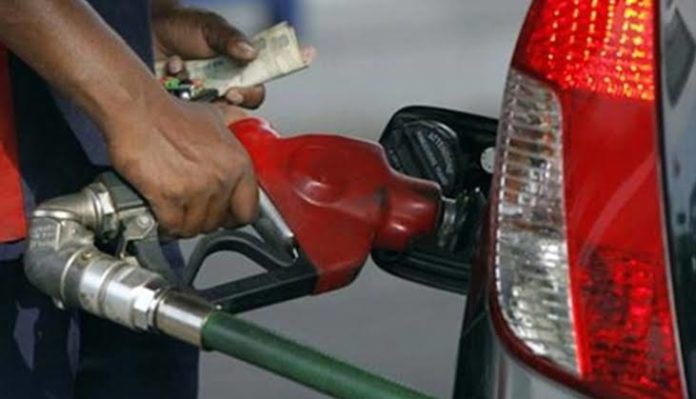
The Federal Government on Thursday said it would crash the price of petrol by providing Compressed Natural Gas as an alternative source of fuel for vehicles nationwide.
The CNG is a fuel that can be used in the place of Premium Motor Spirit, popularly known as petrol. It can also be used in the place of diesel and Liquefied Petroleum Gas.
Speaking on what the Federal Ministry of Petroleum Resources would work on this year during a press conference in Abuja, the Minister of State for Petroleum Resources, Timipre Sylva, stated that the Federal Government was working for the passage of the Petroleum Industry Bill before May.
He further stated that moves by the Federal Government to recover $62bn from international oil companies were seemingly impossible, as no such money was sitting anywhere to be harvested by the country.
Sylva further declared that the Nigerian oil and gas sector was retrogressing, particularly when compared to oil sector of other nations.
He stated that the use of petrol had caused serious drain on the finances of the Federal Government as a result of the continued subsidy on the commodity.
Explaining how the government intends to crash petrol price, Sylva said, “When you say we are thinking about reducing the pump price of petrol, I could easily say yes. Why I could say yes is because we are looking at giving the masses an alternative.
“Today, we are using the PMS but what we want to do, going forward, is to see that we are able to move the masses to the CNG. If we take all transport vehicles to the use of the CNG, you would have impacted the poor positively.”
Sylva said findings by government showed that the CNG cost less than the subsidised PMS and that once the CNG was fully deployed, the price of fuel would crash.
“The subsidised rate of the PMS per litre is N145 but the CNG cost between N95 to N97 per litre and that is why I said that we want to reduce the cost of fuel,” he stated.
He said Nigeria had abundant gas and that deploying the CNG would not be tough for the country.
“Nigeria’s gas reserve is significant. Nigeria currently has estimated 202TCF (trillion standard cubic feet) of gas, with a projection of 600TCF,” Sylva said.
On the PIB, the minister said, “We are optimistic that both the Petroleum Industry Governance Administration and Host Communities Bill, on the one hand, and the Petroleum Industry Fiscal Bill, on the other hand, will be passed within the first anniversary of the second tenure of this administration.”
Commenting on moves by the Federal Government to recover $62bn from international oil companies based on an October 17 judgment of the Supreme Court, Sylva stated that it was practically impossible to recoup such funds from the IOCs.
He declared that no $62bn was anywhere for release by the IOCs and explained that it was best for the government to sit and discuss with the oil firms on how to go about the issue.
The Federal Government had through the Office of the Attorney-General of the Federation written to the IOCs, demanding various sums of money on the basis of the Supreme Court judgment.
The court had ordered the Federal Government to recoup all revenues lost to oil-exploring and exploiting companies due to wrong profit-sharing formula since August 2003.
Sylva said, “Yes there was a provision in the amended Deep Offshore Act, but when we had crude oil prices above $20 per barrel, the Federal Government should have asked for some form of increase in its take.
“Unfortunately we didn’t activate that aspect. You will not blame the Federal Government or the oil companies for not activating that aspect of the Act. You will agree that $62bn could not have been sitting somewhere for us to harvest; it is not possible.”
The minister stated that Nigeria was retrogressing in the oil sector, particularly when compared to other nations that started at similar times with Nigeria in the oil and gas business.
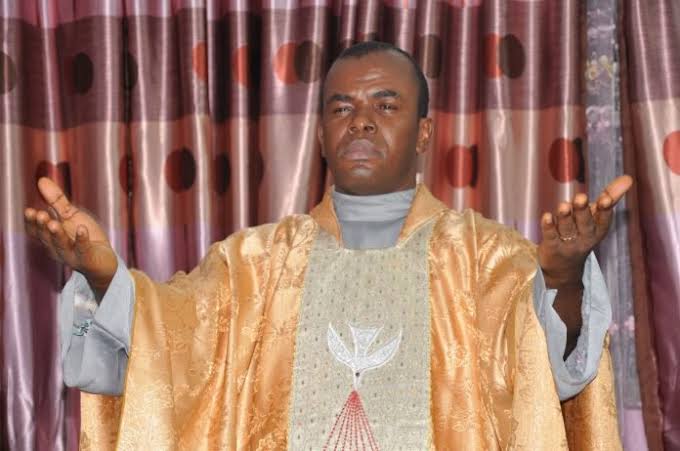
The Catholic Archbishop of Lagos, Adewale Martins, says the Spiritual Director of the Adoration Ministry, Enugu, Rev. Fr. Ejike Mbaka, could be banned from preaching if he continues to deviate from the doctrines and tenets of the Catholic Church.
Martins, who was appointed Archbishop of Lagos by the Pope in 2012, said this during an interview with the BBC Igbo while reacting to Mbaka’s prophecy that Hope Uzodinma would emerge as governor of Imo State.
Mbaka had on New Year’s Eve prophesied that Uzodinma would emerge as governor in 2020, a prophecy which came to pass on Tuesday when the Supreme Court sacked Emeka Ihedioha and named Uzodinma as the duly elected governor.
Reacting to the prophecy, which has stirred heated debate, the archbishop said Mbaka was under the Diocese of Enugu and did not report to him.
He, however, said if Mbaka continued in the manner he was doing things, the Catholic Church may bar him from ministering.
Martins said, “Fr. Mbaka falls under the authority of the Bishop of Enugu Diocese and therefore he has the responsibility of cautioning him. I can imagine that this must be giving the bishop some challenges.
“It must be giving him a bit of a headache and I feel sorry for him and I hope he will find some way of dealing with this matter that has been recurring. Of course, what could be done in the end is either to say, ok you receive the sanction of being stopped from public ministry. That is a possibility. If it is not done, there must be a reason.”
Martins, who was ordained a priest in 1983, said the Catholic Church does not engage in partisan politics.
He said even if Mbaka received a prophecy from God, he ought to ensure that his conduct corresponds with the scriptures and the doctrine of the Catholic Church.
The archbishop added, “It is utterly surprising that Fr Mbaka would go as far as naming one person as governor against another. It is embarrassing when you hear of priests or people in position of authority making statements that are clearly partisan.
“The position of the Catholic Church on matters that have to do with politics is not to be partisan. Of course, we as a church cannot be oblivious to political events and happenings in the country or the world at large and therefore we must speak from the point of view of principles.
“The priest who believes he has a gift of prophecy has to test whatever has been told to him in the light of the scriptures, in the light of the teachings of the church and in terms of the authority that has been given to leaders in the church.”
Martins said Mbaka’s behaviour was at variance with the teachings of the Catholic Church and he had fallen below the standard expected of priests.
Mbaka, who was ordained a Catholic priest in 1995, has been known to give many controversial prophecies.
In 2002, he prophesied that the then Governor of Enugu State, Chimaroke Nnamani, would not return to office in the election but the governor won a second term.
In 2015, Mbaka prophesied that President Goodluck Jonathan would lose to the current President, Maj Gen Muhammadu Buhari (retd.), which came true.
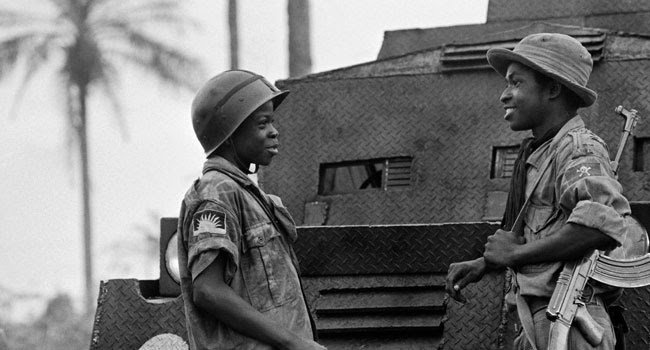
Fifty years ago, a devastating civil war that killed more than one million people in Nigeria came to an end.
Most of those who lost their lives in what became known as the Biafran war died from fighting, disease and starvation during the two-and-a-half-year conflict.
In 1967, Emeka Odumegwu-Ojukwu, the military governor of Nigeria’s then-Eastern Region inhabited mainly by Igbo people, accused the federal government of marginalising and killing thousands of ethnic Igbos living in the north.
On May 30 of that year, Odumegwu-Ojukwu declared the former Eastern Region a sovereign and independent republic under the name of Biafra – a unilateral move rejected by the federal authorities.
A bloody civil war ensued, with federal troops deployed to stop the secessionist movement.
The Nigerian forces cut off aid and access to the area throughout the war, which ended with the surrender of Biafra in January 1970.
The Republic of Biafra ceased to exist and General Yakubu Gowon, the leader of the federal government, famously declared that there was “no victor, no vanquished” in the war.
Fifty years on, the scars are yet to heal for many, including former fighters who suffered injuries and others who lost their loved ones and suffered huge economic losses.
On Monday, at a “Never Again” conference held in Nigeria’s commercial capital of Lagos, Igbo leaders from the southeast urged the government to step up development efforts in the region and called for increased political inclusion and economic support to end fresh calls for a breakaway Biafra state.
In 2017, a regional court ordered the Nigerian government to pay 50 billion nairas ($138m, today’s prices) in damages to civil war victims. The Economic Community of West African States Court of Justice also ruled that 38 billion nairas ($105m, today’s prices) should be put towards evacuating abandoned lethal weapons which deprived southeast communities of farmland since the civil war ended.
But for Canada-based Igbo leader Benjamin Allison, financial reparation is not enough.
“You cannot compensate anyone for past injuries without an acknowledgement that a damage or harm had been done to them. Nonetheless, the only true compensation the Igbos seek from Nigeria at this point is a government based on fairness, equity and justice,” Allison said.
Nigerian President Muhammadu Buhari in 2017 approved the payment of pensions of former police officers who served in Biafra during the civil war. The officers were granted a presidential pardon in 2000 by former President Olusegun Obasanjo.
The Nigerian government has repeatedly said it is committed to developing the region and recently undertook a series of road projects.
But Vincent Nnanna, who was barely 10 years old when the civil war broke out and was recruited to assist the Biafran soldiers with clerical work in Abia state, is not convinced by the government’s efforts so far.
“The clamour for equity and respect for fundamental human rights by the Igbos in particular and the southeast at large has continued to fall on deaf ears,” he said.
‘Continued agitation’
Separatist sentiment has not been wished away, and in recent years the pro-Biafra movement has seen some resurgence. The red, black and green flag of Biafra with a rising golden sun still dots the frontage of some commercial buildings and houses in the southeast region.
Rights group Amnesty International accused the country’s security forces of killing at least 150 Biafra separatists at peaceful rallies between August 2015 and August 2016 and detaining hundreds demonstrating in support of a breakaway state. The military and police denied the allegations.
Nnamdi Kanu, a leader of the Indigenous People of Biafra (IPOB) group, is the most visible face of the movement. He was held for nearly two years for treasonable felony charges before being granted bail on health grounds in April 2017.
Kanu fled Nigeria under controversial circumstances in 2018 but still coordinates the group’s activities from his base in the United Kingdom.
In 2017, following a number of IPOB-organised protests across Nigeria over a period of years, the government banned the group and declared it a “terrorist organisation”.
“They masquerade as a separatist movement, yet they endanger the very people they claim to represent,” Information Minister Lai Mohammed said in a 2017 statement about the government’s move to outlaw the group.
“In reality, IPOB cares about IPOB and nothing more.”
The government’s pronouncement, however, has not stopped the group’s activities – especially overseas where it enjoys the support of millions of Igbos in the diaspora.
“Continued agitation for Biafra is impelled and spurred by state-sponsored or supported injustice which left most Igbo youth with a sense of hopelessness and lack of outlets to express their … talents, potentials and ambitions,” Allison said.
He alleged that no real effort has been made to develop the region, support business, create jobs and ensure adequate security.
Nnanna, however, said he is not happy with the approach of those leading the calls for a new Biafra.
“The regrets I have over Biafra is that since after the death of the forebears, some mercenaries have emerged on the scene purporting to have the spiritual mandate to champion the Biafran cause to a positive conclusion – only for them to herd the … crowd onto a blind alley, leaving the agitators confused and almost disillusioned,” Nnanna said.
Meanwhile, Mohammed Sarki, a public affairs analyst, called for more efforts towards reconciliation.
“The continued discussions about the Biafra war won’t help the country to move forward. Our leaders already declared that no side won the war. We need to forget the past and focus on how to fix Nigeria,” Sarki said.
“The civil war was not a pleasant experience for many people, not just Igbos. We are better as a united country.”


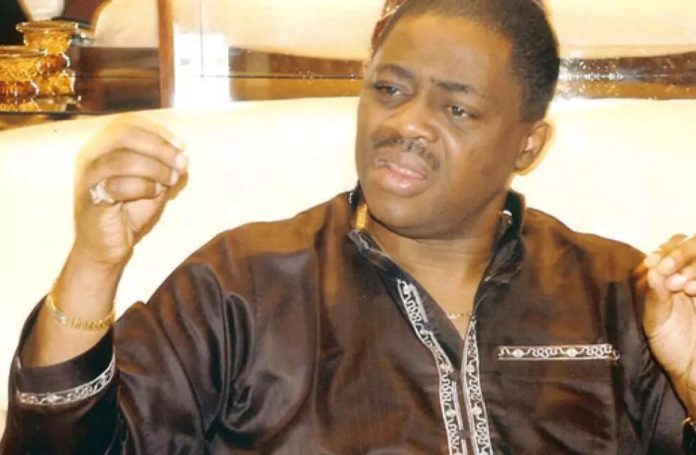
 Former Minister of Aviation Femi Fani-Kayode has warned President Muhammadu Buhari against arresting Yoruba leaders over the establishment of a security outfit for the South-west, code name Operation Amotekun.