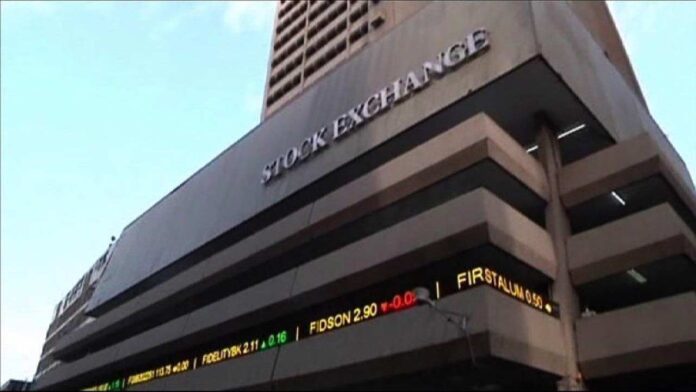
The Nigerian Stock Exchange (NSE) has announced that the revised Stamp Duty on securities transactions from 0.075 percent to 0.08 percent will take effect from December 7.
This is contained in a notice by the NSE made available to the News Agency of Nigeria (NAN) on Thursday in Lagos.
According to the notice, the change is necessitated by the classification of Contract Notes as an ad valorem tax by the Federal Inland Revenue Service (FIRS).
The notice read in part: “As a responsive self-regulatory organisation, the NSE is committed to enforcing rules and ensuring compliance with regulations and other applicable government requirements.
“While it had maintained a stamp duty rate of 0.075 per cent in line with what was obtainable in the Nigerian capital market, it is imperative that the FIRS’ stamp duty regime of 0.08 per cent on securities transactions is applied.
“To this end, the Central Securities Clearing System Plc (CSCS) will adjust its system to implement the automated deduction of the Stamp Duty rate of 0.08 per cent from Monday, Dec. 7.
“The Exchange has also issued the requisite guidance to Dealing Member Firms to put in place the necessary measures to ensure compliance and communicate this change to investors in a timely manner.
“Capital market stakeholders requiring further information can refer to the market circular issued by the Exchange on 17 November captioned “Administration of Stamp Duty on Securities Transactions”, which can be accessed on NSE’s website.
“Investors are also advised to contact their respective stockbrokers for more information or clarification,” it read.
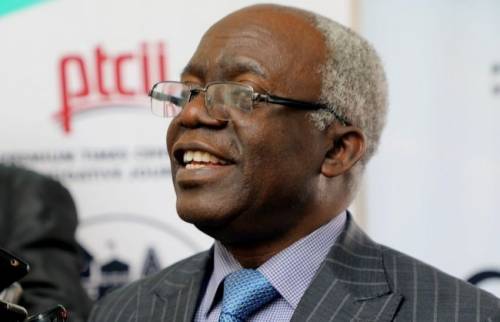
The Central Bank of Nigeria on Monday introduced a new rule that allows beneficiaries of diaspora remittance to receive their money in foreign currencies, months after court action by human rights lawyer, Femi Falana.
Before now, beneficiaries of diaspora remittance could only receive in cash the naira equivalent of the amount transferred. In addition, foreign currencies’ cash withdrawal from domiciliary accounts was restricted to only cash deposit.
Falana had in a petition dated October 21, 2019 and addressed to former acting chairman of the Economic and Financial Crimes Commission, Ibrahim Magu, asked for an investigation of banks, Western Union and MoneyGram for substituting naira for dollar remittances.
He referred to a remark by Boss Mustapha, the Secretary to the Government of the Federation at the 2019 National Diaspora Day celebration in July 2019, where the SGF was quoted as saying the remittances received from Nigerians stood at $19.6 billion, $22 billion and $25 billion in 2016, 2017 and 2018 respectively.
Falana argued that it was a contravention of the Foreign Exchange Act and the Money Laundering Act that the CBN granted banks, Western Union and MoneyGram the authority to pay beneficiaries of remittances in naira while retaining the dollar.
As a follow-up on his request for a probe, Falana, through his chambers, wrote to the CBN on February 10, 2020, demanding to know the accurate remittances for 2016, 2017 and 2018 respectively.
The request, according to the law firm, became necessary after it was discovered that the CBN had quoted a misleading figure in order to downplay the volume of money sent home by Nigerians living abroad.
For instance, in February 2019, the Nigerian government disclosed that the remittances received in the country in 2016, 2017 and 2018 were $19.6bn, $22bn and $25bn respectively.
However, the management of the Central Bank of Nigeria faulted the figures, going ahead to claim before the House of Representatives’ Committee on Diaspora that contrary to the World Bank’s report, the official financial inflow was $2.6bn for 2018.
To clear the air on the matter, Falana’s chambers in the letter to the CBN pointed out that, “At the 2019 National Diaspora Day held at Abuja in July 2019, the Secretary to the Government of the Federation, Boss Mustapha, revealed that the remittances received by Nigeria stood at $19.6bn, $22bn and $25bn in 2016, 2017 and 2018.
“According to Mr Mustapha, the money is currently utilised as social security funds to families (school fees, feeding allowances, hospital bills and so on). Some of it is invested in housing and estate development, hospital projects, schools and commercial enterprises but are not properly documented and analysed for impact.
“Springing from the above statement from the Secretary to the Government of the Federation, we request to be furnished with the official figures of remittances received by Nigeria from the Diaspora for 2016, 2017 and 2018. Please be informed that this request is anchored on the Freedom of Information Act, 2010.”
In a response to the request on June 29, 2020, more than four months after the seven days required by law for FOI requests to be responded to, the CBN in a letter signed by its director of corporate secretariat, C.E Olonta, said it could not respond because the information sought was already on its website.
Further findings, however, revealed that even though all remittances are recorded by the CBN on a daily basis, the management has refused to disclose the real figures.
Falana then proceeded to the Federal High Court, Abuja, where his chamber instituted a court action against the CBN for its refusal to release the requested information on foreign remittances.
In a suit dated July 28, Falana requested an order of mandamus compelling the respondent (CBN) to provide the official figures as requested.
He argued that the information was needed to provide clarity on Nigeria’s foreign remittances as figures provided by some newspapers and credited to Mustapha were contradictory.
The suit reads: “The failure of the Respondent to furnish the Applicant with the details of her request is unlawful and in contravention of the provision of the Freedom of Information Act.
“That the information requested by the Applicant was never published by the Respondent on its websites claimed in the letter dated 29th June 2020.
“That a prerogative writ of mandamus can be issued or ordered by the court to secure or compel the Respondent to furnish the Applicant with the official figures of Diaspora remittances received by Nigeria for the years: 2016, 2017, and 2018 respectively under Section 20 of the Freedom of Information Act 2010.”
With the new directive by the CBN, Nigerians who receive foreign currencies through money transfer operators like Western Union or Moneygram can withdraw in dollars.
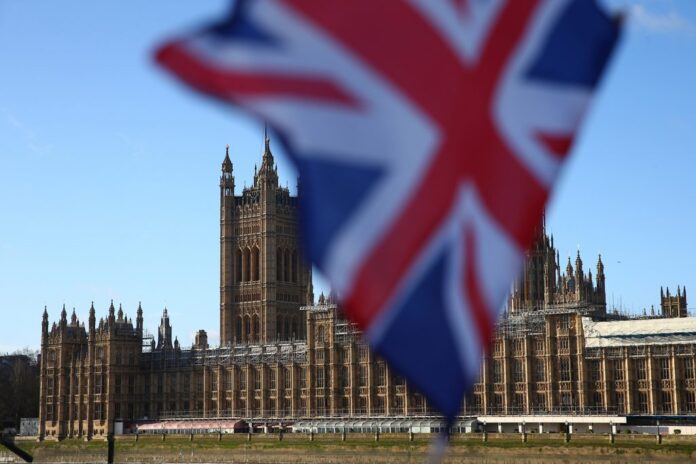
The United Kingdom said it has opened a skilled workers visa application for Nigerians and other foreign nationals intending to migrate and work in the country.
“Applications for the new skilled worker visa open today (1 December), meaning the brightest and the best from around the world can now apply to work in the UK from 1 January 2021,” UK government said in an article on its website.
Under the points-based immigration system, the UK government said, points will be awarded for a job offer at the appropriate skill level, knowledge of English and being paid a minimum salary. Skilled worker visas will be awarded to those who gain enough points.
“The new immigration rules will ensure that businesses can recruit the most highly qualified from across the globe to drive the economy forwards and keep the UK at the frontier of innovation,” the government said.
It will also encourage employers to focus on training and investing in the UK workforce, driving productivity and improving opportunities for individuals, especially those impacted by coronavirus.
UK Home Secretary, Priti Patel, said the “government promised to end free movement, to take back control of our borders and to introduce a new points-based immigration system. Today, we have delivered on that promise.
“This simple, effective and flexible system will ensure employers can recruit the skilled workers they need, whilst also encouraging employers to train and invest in the UK’s workforce.
“We are also opening routes for those who have an exceptional talent or show exceptional promise in the fields of engineering, science, tech or culture.”
Patel disclosed that people will normally “need to be paid at least £25,600 per year unless the ‘going rate’ for that job is higher.”
Applications are made online, and as part of this, people will need to prove their identity and provide their documents. Once someone outside the UK has gone through all these steps, they will usually get a decision within 3 weeks.
“They will need to have enough money to pay the application fee (ranging from £610 to £1,408), the healthcare surcharge (usually £624 per year) and be able to support themselves (usually by having at least £1,270 available),” the government said.
“The visa lasts for up to 5 years before it needs to be extended.”
The student route and Child Student route visa system opened on 5 October 2020 to eligible international students from across the globe.
Arik Air operations were on Thursday grounded by the National Union of Air Transport Employees over poor working conditions.
The workers blocked the entrance of the airline’s headquarters, carrying placards with different inscriptions.
Some of the inscriptions read, “End Arik brutality”, and “Sign our condition of service and recall all staff”.
They alleged that several members of staff had been furloughed, adding that pensions were being owed.
State Secretary of NUATE, Ijeh Anthony, explained that the issue had lingered for long, vowing to continue the strike till all demands are met.
He said, “The contentious issue is the signing of the Conditions of Service which we have been negotiating for the past three years.
“But the only aspect remaining in the CoS is the issue of the severance package. We have sought interventions from the Ministry of Aviation, the Nigerian Civil Aviation Authority.
“However in most discussions, Arik Air Management will always renege.”
At the MM2 terminal, several passengers booked for 8 am flights were stranded.
Some of the passengers, who spoke to The PUNCH, were distraught after waiting for several hours.
Officials from the airline were seen trying to manage the situation.
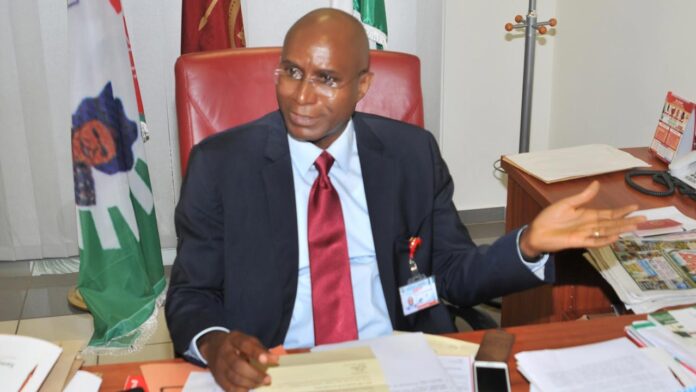
Deputy Senate President, Ovie Omo-Agege, has urged Nigerians not to engage in wishful thinking that the 9th National Assembly would deliver a new constitution, saying it lacks the mandate to do so.
According to a statement by his Special Adviser on Media and Publicity, Yomi Odunuga, Omo-Agege made the comment when he hosted members of the Alliance of Nigerian Patriots led by Ambassador Umunna Orjiako in Abuja.
The deputy senate president, who chairs the Adhoc Committee on Constitution Review, explained that the National Assembly had no powers to replace the current constitution of the country but could only amend it.
He cited advanced democracies like the United States of America after which Nigeria’s presidential system of government was fashioned as well as Sections 8 and 9 of the 1999 Constitution (as amended), saying what is obtainable is piecemeal alteration of the constitution.
Omo-Agege, therefore, urged those calling for a brand new constitution to channel their energy towards participating actively in the ongoing amendment by the National Assembly.
“One of the issues you raised is the replacement of the 1999 Constitution. I am not so sure that we, as a parliament, have the power to replace the constitution. We can only make amendments. And it is explicit in Sections 8 and 9 of the constitution how we can do that and the requisite number of votes required.
“I say that because there are some top attorneys in this country who, for some reasons, keep saying that we don’t even need any of this, that we should just bring a new constitution. We can’t do that. What we are mandated to do by law is to look at those provisions and bring them up-to-date with global best practices, especially to the extent that they tally with the views of the majority of Nigerians. So we are not in a position to replace this constitution but we can only amend,” he said.
The lawmaker described the proposal by the delegation that zones should replace states as another euphemism for going back to the regions.
“We will look into that if that is what majority of our people want. You talked about devolution of powers. The preponderance of views we have received so far is that those 68 items are very wide and need to shed some weight and move them to the Concurrent Legislative List,” he said.
On the call for scrapping of the upper legislative chamber, Omo-Agege said;
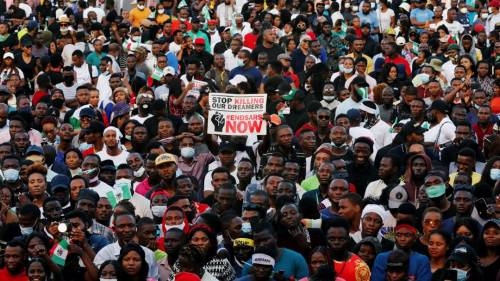
“One of the issues raised by #EndSARS protesters was that the government should abolish the Senate and merge us with the House of Representatives. We are not in a position to do that. Mr. President is not even in a position to do that as well.”
Earlier, Orjiakor called for the reconfiguration of the present 36 states structure into six zones as federating units, drastic cut in the Exclusive Legislative List and expansion of the Concurrent Legislative List, reform of the National Assembly to a hybrid presidential and Westminster systems, abolition of security votes to be replaced by regular security budget allocations and electoral reforms to ensure a truly independent Independent National Electoral Commission (INEC).
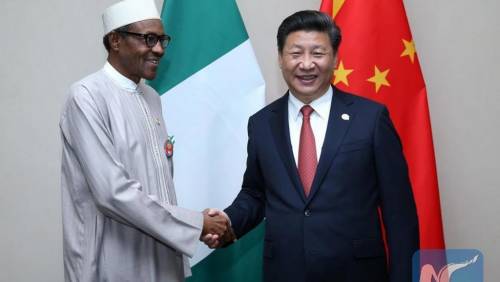
Nigerian President Muhammadu Buhari and Chinese President, Xi Jinping
Nigeria, Africa’s biggest oil producer and exporter, has resumed importation of petrol from China, the world’s top crude oil importer.
The Asian country shipped 37,000 metric tonnes of petrol to Nigeria in September for the first time since July 2019, data from the General Administration of Customs showed, according to S&P Global Platts.
China, a major exporter of transportation fuels, has extended exports to Africa in recent years.
The first African country to receive Chinese petrol was Togo in April 2018 at 50,000 mt, followed by Nigeria in January 2019 at 51,000 mt, historical GAC data showed.
The most recent diesel exports from China to Africa were in June, with Kenya and South Africa receiving 40,000 mt and 35,000 mt, respectively, according to the data.
China’s annual crude oil imports increased by 0.9 million barrels per day in 2019 to an average of 10.1 million bpd, according to the United States Energy Information Administration.
The EIA said China’s new refinery capacity and strategic inventory stockpiling, combined with flat domestic oil production, were the major factors contributing to the increase in its crude oil imports in 2019.
Last year, China’s refinery capacity increased by 1.0 million bpd, primarily because two new refining and petrochemical complexes came online with capacities of 0.4 million bpd each.
As a result, the country’s refinery processing also increased to an all-time high in 2019, averaging 13.0 million bpd for the year, according to the EIA.
Nigeria has continued to rely heavily on importation for many years to meet its fuel needs as the nation’s refineries remain in a state of disrepair.
Uneven demand recovery in Africa has led to a divergence in support for Asian transportation fuel markets as diesel and jet fuel requirements weaken while demand for petrol remains robust, industry sources said.
The slowdown in Africa’s diesel and jet fuel demand, in particular, has removed a significant pillar of support from Asian, middle distillate markets after buying them for most of the third quarter, a report by Punch quoted sources to have said.
The African continent draws most of its petrol and middle distillate imports from the Persian Gulf and the Mediterranean, and an increase in demand typically lends indirect support to Asia, market sources said.
The Nigeria Police Force has filed a suit at the Federal High Court in Abuja praying for an order stopping the various states’ judicial panels of enquiry probing allegations of rights abuses and other acts of brutality of the disbanded Special Anti-Robbery Squad and other police tactical units.
The plaintiff in the suit marked, FHC/ABJ/CS/1492/2020, urged the court to restrain the Attorneys-General of the 36 states of the federation and their various panels of enquiry from going ahead with the probe focussing on police impunity.
The defendants, totalling 104, who were sued by the NPF, comprised the Attorney-General of the Federation, the National Human Rights Commission which set up the Independent Investigative Panel sitting in Abuja, the Attorneys-General of the states, and chairmen of the states’ panels.
The decision to set up the various panels of enquiry was taken by the National Economic Council with members including the 36 state governors and Vice President Yemi Osinbajo, in the aftermath of the recent nationwide #EndSARS protests demanding an end to police brutality.
The NPF, through their lawyer, Mr O. M. Atoyebi (SAN), argued in the fresh suit that the state governments lacked the power to constitute the panels to investigate activities of the police force and its officials in the conduct of their statutory duties.
According to the plaintiff, the state governments’ decision to set up such panels violated the provisions of section 241(1)(2)(a) and Item 45, Part 1, First Schedule to the Constitution and Section 21 of the Tribunals of Inquiry Act.
It argued that by virtue of the provisions of 241(1)(2)(a) and Item 45, Part 1, First Schedule to the Nigerian Constitution only the Federal Government had exclusive power to “organise, control and administer the Nigeria Police Force”.
It, therefore, urged to, among others, declare that “the establishment of a panel of enquiries by the governors of the various states of the federation of Nigeria, to inquire into the activities of the Nigeria Police Force in relation to the discharge of her statutory duties is a gross violation of the provisions of Section 241 (1)(2) (a) and Item 45, Part 1, First schedule, 1999 Constitution of the Federal Republic of Nigeria (as amended) and Section 21 of the tribunals of inquiry Act, Cap.T21, Laws of the Federation of Nigeria, 2004”.
The plaintiff also urged the court to declare that “having regard to the circumstances of this case, the attitude of the governors of the various states of the Federation of Nigeria, in this case, is unconstitutional, illegal, null and void and of no effect whatsoever”.
It sought an order of perpetual injunction restraining the 3rd to 38th defendants (the state Attorneys-General of the 36 states) “from making or conducting any investigations, sittings, and inquiries and/or from making or conducting any further investigations, sittings and inquiries in respect of matters affecting the Nigeria Police Force, and or further setting up any panel of inquiry in any state whatsoever in the country”.
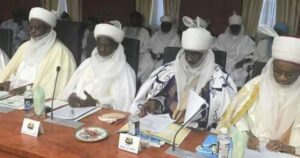
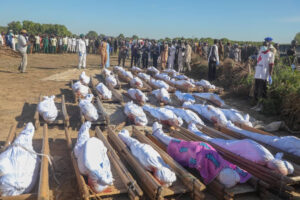
The Northern Elders’ Forum (NEF) has reacted to the attack of 43 rice farmers in Borno State who were beheaded by Boko Haram insurgents during a fatal attack on Saturday.
In a statement signed on Tuesday by Director of Publicity and Advocacy of the northern elders forum, Dr. Hakeem Baba-Ahmed, they called for the resignation of President Muhammadu Buhari, following the spate of insecurity in the country.
“The northern elders said In civilized nations, leaders who fail so spectacularly to provide security will do the honourable thing and resign,” the statement concluded.
The Northern elders made the call while lamenting that the lives of Nigerians no longer have value under Buhari’s administration and thus added that the President should toe the path of honour and resign for failing to ensure the security of Nigerians.
Reacting further, the Northern elders added that the attack on the farmers was greeted by the most insensitive response by spokespersons of the President who gave a lame excuse that farmers had not sought permission from the military to harvest produce upon their attack.
The statement by the Northern elders reads thus in full; “Northern Elders Forum (NEF) joins Nigerians in expressing outrage at the killings of farmers in Borno State and many other people on a daily basis in many parts of the North. Our voices have been raised without pause for a long time against pervasive insecurity in our region.
“These particular killings have been greeted by the most insensitive response by spokespersons of the President. The lame excuse that farmers had not sought permission from the military to harvest produce merely exposed the misleading claims that our military had secured vast territories from the insurgency.
“Under this administration, life has lost its value, and more and more citizens are coming under the influence of criminals. We do not see any evidence of a willingness on the part of President Buhari to honor his oath to provide security over Nigerians.
“In civilized nations, leaders who fail so spectacularly to provide security will do the honourable thing and resign,” the statement concluded.
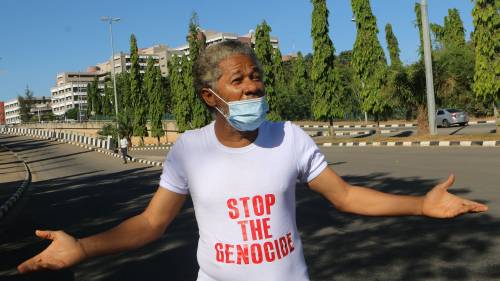
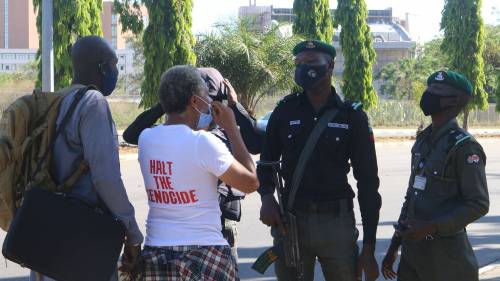
A Lagos State-based lawyer and activist, Malcolm Omirhobo, has been arrested at the Presidential Villa gate in Abuja by the operatives of the Department of State Services while embarking on a “one-man protest” against the killing of at least 43 farmers in Borno State.
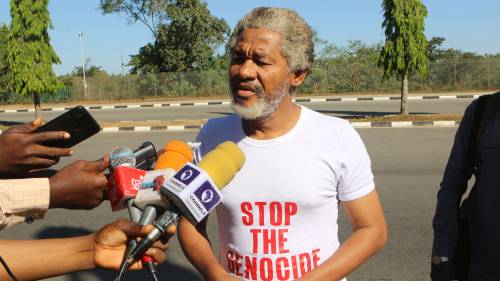
The lawyer, who arrived at the gate at about 9 am and clad in a customised T-Shirt with an inscription, “Stop The Genocide” alongside some journalists, was whisked away by the officers in a Gestapo manner.
Omirhobo had come to the villa gate to protest against the gruesome killing of the rice and fish farmers in Zabarmari community.
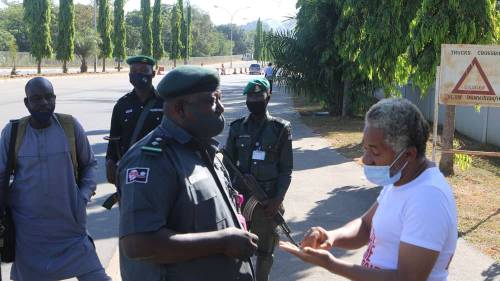
The activist was stopped by the policemen attached to the gate near the Federal Secretariat while heading toward the Presidential Villa.
An argument ensued in the process as the lawyer insisted on seeing President Muhammadu Buhari in order to tell him to stop the carnage and the senseless killing of Nigerians in the country.
The police put a call to one of their superior officers, Hadejia, who appealed and pacified Omirhobo to write a formal letter if he wanted to have an audience with the President.
But trouble started when the armed DSS officials arrived at the scene, descended on the activist and harassed the journalists covering the scene.
Addressing journalists before his arrest, Omirhobo said he had come to the Presidential Villa to protest peacefully against the institutionalised and systemic genocide going on in Nigeria.
He said, “Coming on the heels of the slaughtering of 110 farmers in Borno State, I am here to tell the President that enough is enough. He should stop playing the ostrich because the government is backing all the evils perpetrated by these evil people killing innocent and harmless Nigerians.
“I am saying it categorically that the government is conniving, conspiring and assisting this crime against humanity, and that is why I am here to protest. I came here now, but the officers are saying that I cannot exercise my rights.”
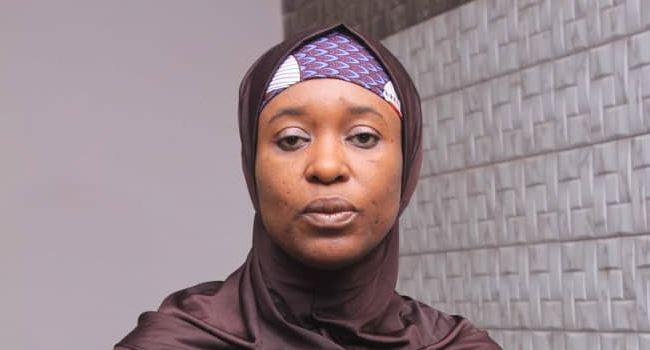
Human rights activist and co-convener of the BringBackOurGirls Movements, Aisha Yesufu, has decried the failure of President Muhammadu Buhari to address the country on the gruesome killings of at least 43 farmers in the Zabarmari area of Borno State.
Yesufu on Twitter lamented that a Boko Haram leader from the Abubakar Shekau faction had addressed the country on Tuesday while the President has yet to make an address.
She noted that this suggested that Nigeria had no leader.
She said, “The leader of the terrorist group has addressed the nation while the ruler of the Federal Republic Of Nigeria has yet to address the country. The terrorists know their leader has got their back. Nigerians have no leader. This hurts!
“The people with the power are kneeling for him and going on errands on his behalf. The legislative arm of government is where we need to focus our attention for now. They have the power to checkmate the executive. We need competent people there.”
The leader of the terrorist group has addressed the Nation while the ruler of the Federal Republic Of Nigeria is yet to address the Nation.
The terrorists know their leader has got their back. Nigerians have no leader.
This hurts! https://t.co/5VkBDYa5dk
Yesufu’s voice is one among national and global condemnation that has greeted the violent massacre of the Borno State farmers last Saturday – an occurrence where sources said over 80 persons were tied and slaughtered.
An infuriated Senate on Tuesday had called on the President to sack the service chiefs who seemed to be lacking ideas to ensure national security. The House of Representatives had also summoned the President to appear before it and answer to the killings.
The Borno State Governor, Prof Babagana Zulum, who seemed to have lost faith in the Nigerian armed forces, had stated on Monday that the President should engage the services of mercenaries to clear the entire Sambisa Forest.
The governor had said, “One of our recommendations as possible solutions to end the insurgency is the immediate recruitment of our youths into military and paramilitary services to complement the efforts of the Nigerian forces.
“Our third recommendation is for the President to engage the services of mercenaries to clear the entire Sambisa forest.”
In three minutes and 37-second video, a masked Boko Haram leader had come out to say on Tuesday that the insurgents carried out the massacre because the farmers arrested one of its members and handed him over to the Nigerian military.