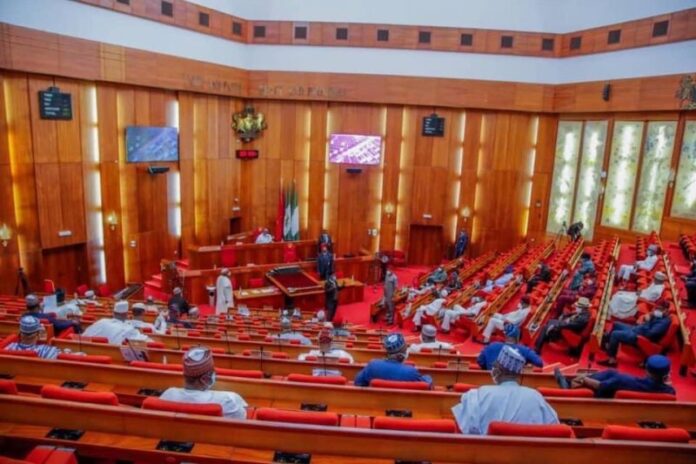
The Senate on Tuesday passed a bill seeking to recognize boys and men as victims of rape.
The bill also prescribes life jail for kidnappers.
The current maximum sentence for the offence is 10 years imprisonment.
The bill contains amendments to the criminal code act.
The proposed legislation, sponsored by Senator Oluremi Tinubu, is titled, ‘A bill for an Act to amend the Criminal Code Act CAP. C.38, Laws of the Federal Republic of Nigeria 2004’.
It also seeks to delete the statute of limitation on defilement, increase punishment for the offence of kidnapping, and remove gender restrictions in the offence of rape and other related matters.
The bill also eliminates the time frame for prosecuting defilement cases by increasing the period from two months to as many years as the victim decides to take up the matter.
It removes gender restrictions on the offence of rape by explaining that both male and female could be raped.
The bill passed third reading on Tuesday after a report on it was presented by the Chairman of the Committee on Judiciary, Human Rights and Legal Matters.
The proposed legislation is coming two weeks after the upper chamber passed a bill to prohibit sexual harassment in tertiary institutions last week.
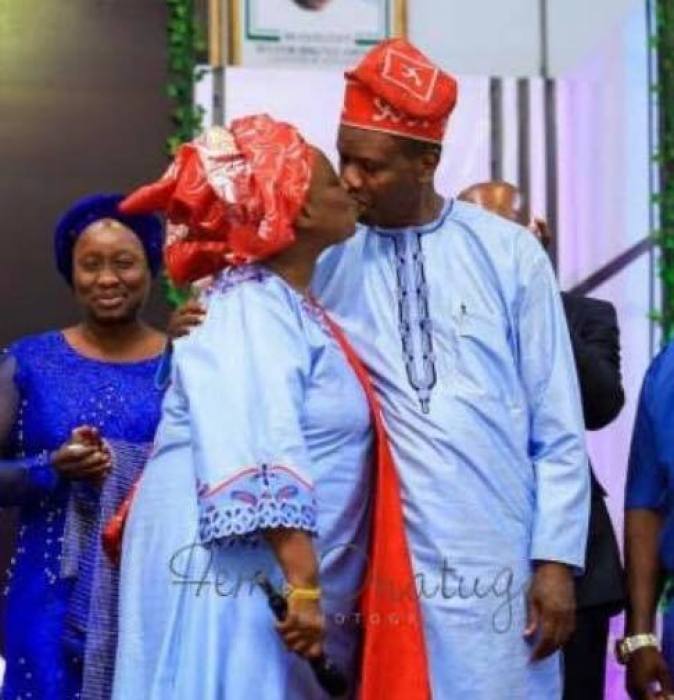
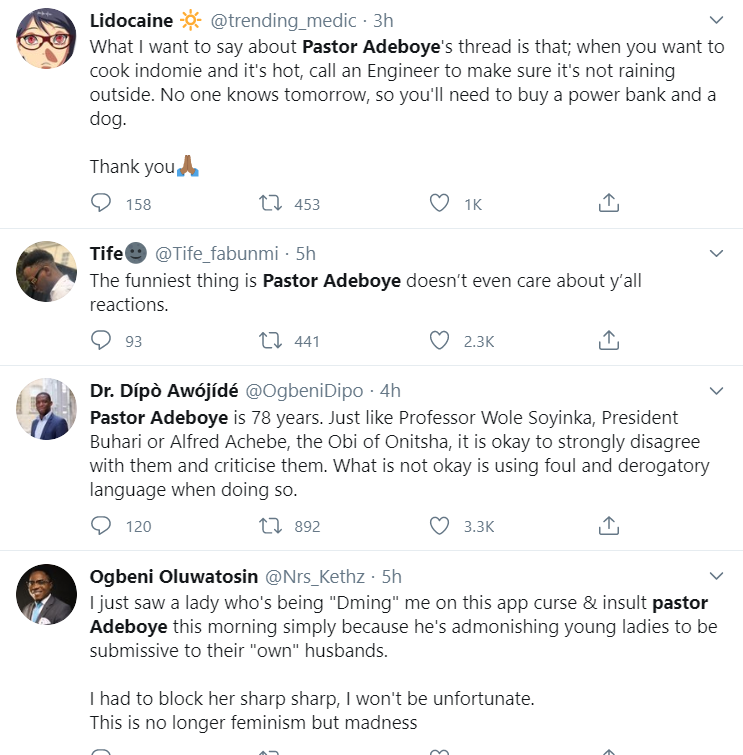
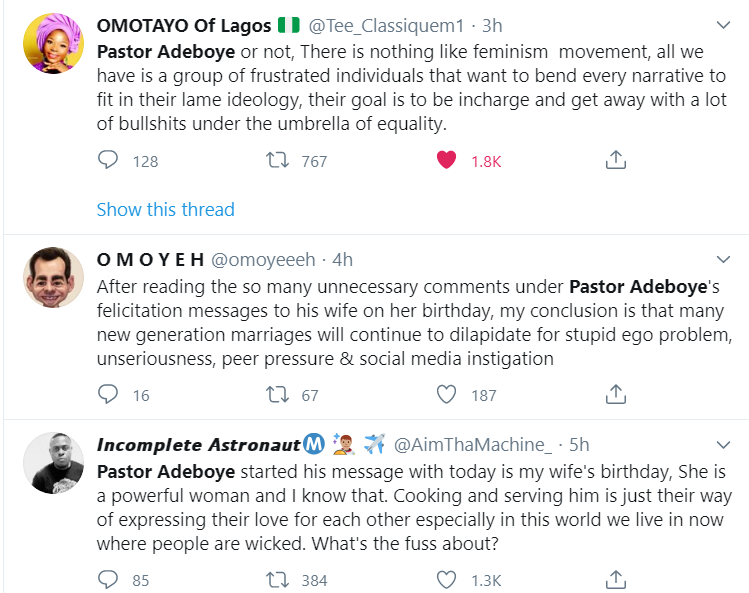
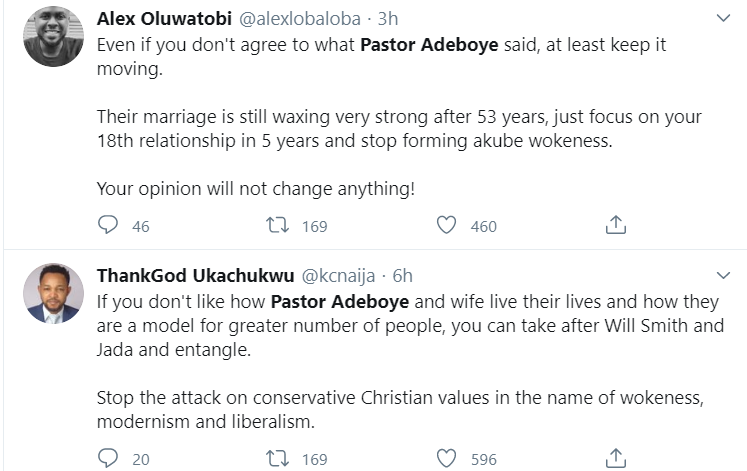
The birthday tributes of General Overseer of the Redeemed Christian Church of God, Pastor Enoch Adeboye, for his wife, Folu, has stirred controversy on social media.
Adeboye, while celebrating his wife who clocked 72, said: “Today is my wife’s birthday and there are lessons that women, especially so many young brides can learn from her.
“She is a powerful woman, I know that. She has many people who take instructions from her but as powerful as she is and even though she has seen me in my weakest moments, I have no doubt that I am her head.
“It does not matter what is on her itinerary if I say I would like you to go with me to so and so place the best she can do is try to convince me otherwise.”
Adeboye, who stressed on women being submissive to their husbands, asserted: “No matter how educated or successful you are, your husband is your head and you must regard him as such at all times.
“It is a terrible thing for a husband to feel his wife is his head. Many men are misbehaving in their marriages simply because they want to establish that they are the head of their wives.”
He further disclosed that despite his wife’s busy schedules, she handles the cooking and serving of the food.
He said: “As busy as she is, she still cooks my meals and serves me herself. Many young ladies these days leave everything to the house help.
“My wife still trims my nails for me. There was a time when I was a teacher and was staying far from town.
“She had to cut my hair during that period. She is the only partner of the Adeboye Corporation; she doesn’t delegate her primary duties to anyone else. Just like the virtuous woman described in Proverbs 31:1-31, I safely rest on my wife.”
However, Nigerians took to social media to express mixed reactions over Adeboye’s tributes.
Police say she was a victim of online romance fraud
An American woman lured to Nigeria by a promise of marriage from a man she met on Facebook has been rescued after being held captive for more than a year, police say.
The 46-year-old was held against her will in a hotel room in Lagos.
The suspect Chukwuebuka Obiaku, 34, “took control” of the unnamed victim’s credit and debit cards, and retirement benefits, according to the police.
Over a period of 15 months she was forced to part with $48,000 (£38,000).
The victim is a retired civil servant from Washington DC.
Police say Mr Obiaku “also used the victim as a front to defraud her associates and other foreign personalities and companies”.
What more do we know?
The victim arrived from the US in February 2019, according to Nigerian police. In May 2019 she married Mr Obiaku.
In total, the woman is said to have been held against her will for 16 months in a hotel room.
The police say they received a tip off from a “civic minded” individual and they used the information to rescue her.
Mr Obiaku has been arrested and police say he faces a charge of cybercrime.
YouTube Star Nicole Thea, Who Was Pregnant With Her First Child, Has Tragically Died at Just 24
YouTube star Nicole Thea’s family has confirmed that she tragically passed away.
Twenty-four-year-old Nicole was pregnant with her first child, who she’d named Reign.
Absolutely heartbreaking news this morning: YouTube star Nicole Thea, who was pregnant with her first child, has died at the age of 24. Nicole’s family confirmed the news in an Instagram post shared on Sunday, writing “To all Nicole’s friends and supporters it is with great sadness that I have to inform you that Nicole and her son she and Boga named Reign sadly passed away on Saturday morning.”
The family went on to explain that Nicole had pre-scheduled several YouTube videos, and her boyfriend Global Boga “has made the decision to allow them to be aired.” They also asked fans for privacy, saying “our hearts are truly broken and we are struggling to cope with what has happened.”
YouTube Star Nicole Thea, Who Was Pregnant With Her First Child, Has Tragically Died at Just 24
The post was signed by her mother, who wrote “RIP My beautiful baby girl Nicnac and my grandson Reign, I will miss you for the rest of my life until we meet again in eternal heaven.”
Nicole announced her pregnancy in April, sharing a video of herself and Global Boga and writing “We are already obsessed with you our little miracle baby. Thank you for choosing us to be your parents and best friends.”
There are no further details as to the circumstances of Nicole’s death at this time, but please keep her family in your thoughts.
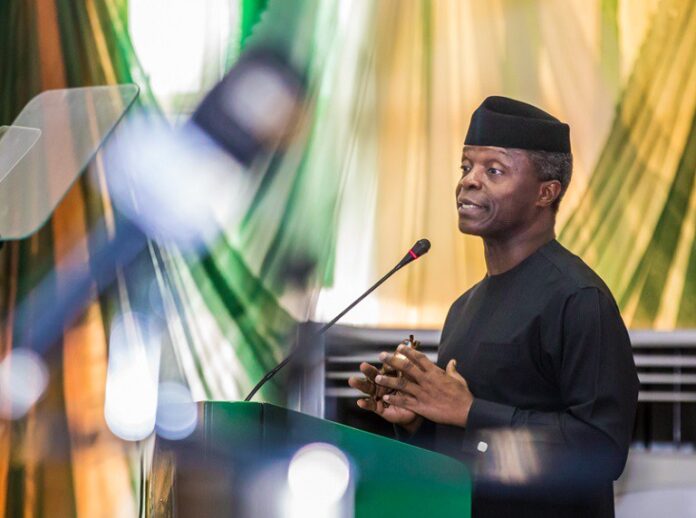
Nigeria’s vice-president, Yemi Osinbajo, has no intention of contesting to be president in 2023, according to his Senior Special Assistant on Media and Publicity, Laolu Akande.
Akande stated this while answering questions on an Instagram Live chat with the publisher of Ovation Magazine, Dele Momodu, on Monday.
Momodu asked Akande if the attacks his principal has faced recently, was part of a plan to disrupt any ambition the vice president has in 2023.
In response, Akande insisted that Osinbajo’s major focus was to support President Muhammadu Buhari until their tenure elapses.
“I’m his spokesperson and all I know he wants to do is to do this job that he has been given very well and he doesn’t have any other plans right now about any such thing. I can tell you that clearly.
“He has said to me several times, see Laolu, this is not a monarchy, we are going to be here for four or at best eight years, let’s just focus and do the work so that when we are gone, people will say we did this and that. So, he is entirely consumed with the job.
“I’m his spokesperson and we have not talked about what he is going to do in 2023. What’s the point?” Akande said.
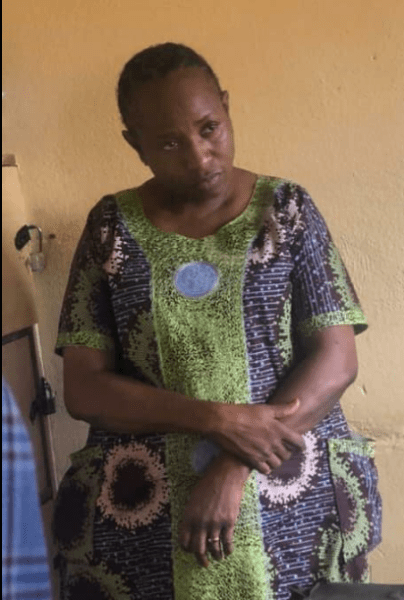
Yemi Awolola, a deaconess with the Living Faith Church also known as Winners’ Chapel, who brutalised a 14-year-old girl put in her care with a hot knife and gas lighter in her genital area, has pleaded guilty to the charges against her.
SaharaReporters also gathered that Awolola inserted a stick in the girl’s vagina.
Awolola, who is reportedly a staff of the Nigeria National Petroleum Corporation, was arraigned on Monday at the Magistrate Court 3, Ibrahim Taiwo Road, Kaduna, on charges of battery and sexual assault.
Despite pleading guilty to the crime, Justice Bashir Yusuf Shittu, the presiding magistrate, said he was unable to convict Awolola because he “lacks jurisdiction” and that he was only taking cognisance of the offence.
Justice Shittu granted bail in the sum of N700,000 to Awolola’s two children, who are also named as accomplices in the matter, but denied the woman bail.
Her son, SaharaReporters gathered, who is also complicit in allegedly abusing Princess, has fled to Lagos after escaping police arrest.
The presiding judge has adjourned the case until August 27 for further hearing while remanding Awolola at the Kaduna Correctional Center.
Recall that the woman and her children allegedly serially abused Princess, who was left in her care after she promised the victim’s financially unstable family that she will send her to school.
The family recently called on Nigerians to ensure that the matter was not swept under the carpet and that their daughter, who is currently hospitalised in Kaduna, gets justice.
Nigeria’s Minister of Aviation, Hadi Sirika, has said the federal government is not in a hurry to announce the resumption of international flights.
Sirika stated this while speaking during the daily briefing of the Presidential Task Force on COVID-19 yesterday.
The Minister made it clear that any decision taken would be in the interest of Nigerians.
He pointed out that several countries have not opened up for international flight operations and that Nigeria has not received clearance to fly to countries who are already receiving foreign visitors.
“Everyone is trying to keep safe. These and many other reasons will make us be cautious and study some more and liaise with stakeholders to decide when we will open international flights.
“Within the sector, we want to reopen because we are bleeding and losing money but we have to remain alive first before we make money. Whatever decision we take has to be in the interest of humanity in general,” Sirika said.
He also added that the World Health Organisation, the Economic Community of West Africa States (ECOWAS) and other aviation stakeholders would be consulted, before any announcement is made.
Popularly known as Moshood Kashimawo Olawale Abiola. He was born in Abeokuta, Ogun State. His father had lost 22 previous children before he was born, which was the reason he was called “Kashimawo,” meaning, “let’s wait and see if he will not die.” He did his first business at age 9 by gathering firewood and selling them. He was a stammerer, who also had a music band of his own at age 15.
Chief MKO Abiola was the editor of his school, Baptist Boys High School magazine, while Nigeria’s former president, Chief Olusegun Obasanjo was his deputy. He graduated with a first class degree in Accounting from Glasgow University, Scotland. He contested and won the presidential election under the defunct Social Democratic Party (SDP) in 1993. The elections were annulled by former military Head of State, Ibrahim Babangida, an election widely believed to be free and fair. Moshood Abiola Polytechnic (MAPOLY) and Moshood Abiola Stadium, both in Ogun state and Abiola Gardens, a Housing Estate in Lagos state were named after him. He was a philanthropist.
Chief Olusegun Obasanjo
Olusegun Obasanjo, (born March 5, 1937, Abeokuta, Nigeria), Nigerian General, Statesman and a Diplomat. He was the first military ruler in Africa to hand over power to a civilian government. He served as Nigeria’s military ruler (1976–79) and, as a civilian, as President (1999–2007).
Obasanjo attended Baptist Boys’ High School in Abeokuta, in southwest Nigeria, and later worked as a teacher. Unable to afford college, he joined the army in 1958 and received officer training in England. Obasanjo rose quickly through the army ranks. During the Biafra conflict (1967–70) he was appointed to head a commando division that was stationed at the Biafran front in southeastern Nigeria. The conflict ended when Biafran forces surrendered to him in January 1970.
2. Sir Abubakar Tafawa Balewa (December 18, 1912 – January 15, 1966)
Sir Abubakar Tafawa Balewa, (born 1912, Bauchi, Northern Nigeria—died January 1966, near Ifo, Nigeria), Nigerian politician, deputy leader of the Northern Peoples Congress (NPC), and the first federal prime minister (1957–66).
A commoner by birth, an unusual origin for a political leader in the NPC, he was a defender of northern interests, an advocate of reform and Nigerian unity. He was Nigeria’s first and only Prime Minister. He was called the Golden Voice of Africa because of his impeccable spoken English. He studied at the University of London’s Institute of Education. Abubakar Tafawa Balewa University, Bauchi was named after him.
3. Dr Nnamdi Azikiwe (November 16, 1904 – May 11, 1996)
Nnamdi Azikiwe, popularly referred to as “Zik“, was a Nigerian statesman, Governor General of Nigeria from 1960 to 1963 and the first President of Nigeria from 1963 to 1966 He was known as Chief Benjamin Nnamdi Azikiwe, the Owelle of Onitsha, Anambra state.
He was born in Zungeru, Niger state. He is from Enugu state. He had a BSc and MSc from Lincoln University and another MSc from University of Pennsylvania. He joined politics first with Nigeria Youth Movement (NYM) and later in 1944 founded National Council of Nigeria and Camerouns (NCNC). He was made the country’s ceremonial president on October 1, 1960. Chief Nnamdi Azikiwe was a Presidential candidate under the platform of the old Nigerian Peoples Party (NPP). Some of the things named after him are: Nnamdi Azikiwe University, Anambra state (UNIZIK) and Nnamdi Azikiwe International Airport, Abuja were named after him.
4. Sir Ahmadu Bello (June 12, 1910 – January 15, 1966)
Ahmadu Ibrahim Bello, Sardauna of Sokoto (12 June 1910 – 15 January 1966), knighted as Sir Ahmadu Bello, was a conservative Nigerian statesman who masterminded Northern Nigeria through the independence of Nigeria in 1960 and served as its first and only premier from 1954 until his assassination in 1966, in which capacity he dominated national affairs for over a decade.
He was born in Rabba, Sokoto state. He was the leader of the Northern Peoples Congress. Sir Ahmadu Bello got scholarship to study Local Government Administration in England. He saw to the modernisation and unification of the various groups and people in Northern Nigeria. The Ahmadu Bello University in Zaria, Kaduna state was named after him.
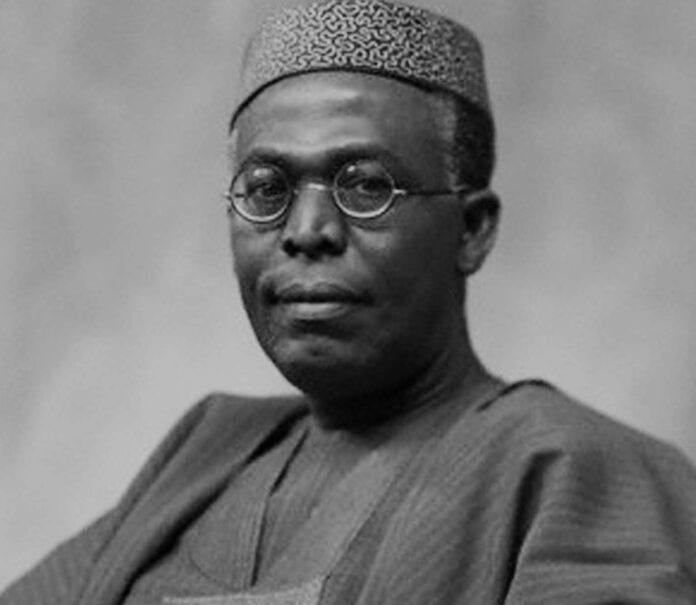
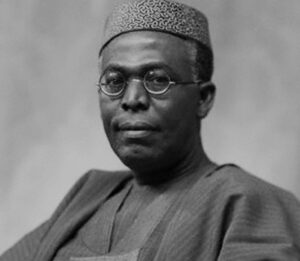
Chief Obafemi Awolowo, also known as Awo, (born March 6, 1909, Ikenne, Colony and Protectorate of Southern Nigeria —died May 9, 1987, Ikenne, Nigeria), Nigerian statesman who was a strong and influential advocate of independence, nationalism, and federalism. He was also known for his progressive views concerning social welfare.
He studied law at the University of London. He was made the federal commissioner for finance between 1967 and 1971. He was the Premier of Western Region from October 1, 1954 to October 1, 1960. Chief Obafemi Awolowo formed the Action Group (AG). He was the presidential candidate of the Unity Party of Nigeria (UPN). The former University of Ife in Osun state, was named after him as Obafemi Awolowo University (OAU).
6. Sir Anthony Enahoro (July 22, 1923 – December 15, 2010)
Chief Anthony Eromosele Enahoro (22 July 1923 – 15 December 2010) was one of Nigeria’s foremost anti-colonial and pro-democracy activists. He was born the eldest of ten children in Uromi in the present Edo State of Nigeria. He joined the Movement for National Reformation during his youth.
He was educated at King’s College, Lagos. He was the editor of the Southern Nigerian Defender newspaper, where he became Nigeria’s youngest editor at 21 years. He was the editor of Zik’s Comet in Kano. He became the Associate Editor of West African Pilot, Lagos from 1945 – 1949. He was Editor-in-Chief, Morning Star from 1950 – 1953. Sir Anthony Enahoro was the first Nigerian to move the motion for Independence in 1953. Enahoro is regarded by many Academics and Nigerians as, “Father of Nigeria State.”
7. Mallam Aminu Kano (1920 – April 17, 1983)
Aminu Kano (1920—April 17, 1983) was a Muslim politician from Nigeria. In the 1940s he led a socialist movement in the northern part of the country in opposition to British rule. He is known with the popular, ‘Talakawa politics’ in Northern Nigeria. His political ideology was based on the poor’s welfare.
He was a staunch member of the Northern Element Progressive Union (NEPU). He was a teacher by profession. He studied at the University of London’s Institute of Education. Mallam Aminu Kano formed the Peoples Redemption Party (PRP). He was the Presidential candidate under PRP during the 1979 general elections. The Aminu Kano Teaching Hospital (AKTH) and Aminu Kano Airport, both in Kano state were named after him.
Chief Samuel Ladoke Akintola was a politician, lawyer, journalist, and administrator. He was the Premier of the Western Region and the Aare Ona Kakanfo (generalissimo) XIII of Yorubaland. He was one of the founding fathers of modern Nigeria.Born in Ogbomosho, Oyo State, on July 10, 1910, Akintola briefly attended CMS School, Minna, before returning to Ogbomosho in 1922 to finish at the Baptist Day School.
He attended Oxford University where he studied Law on a British Council Scholarship in 1946. Chief Ladoke Akintola was made the minister of Health in 1953. In 1959, Akintola became Premier of the Western Region. At the Federal level, he served as Minister for Health and later for Communications and Aviation. He was the first leader of the opposition party in the federal parliament. He was also the first minister of Labour. He was the first post-Independent Premier of Western Region. The Ladoke Akintola University in Ogbomosho, Oyo state was named after him.
9. General Murtala Mohammed (November 6, 1938 – February 13, 1976)
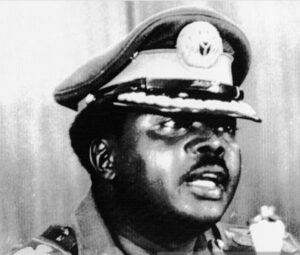
General Murtala Ramat Muhammed (November 8, 1938–February 13, 1976) was a military ruler (Head of the Federal Military Government) of Nigeria from 1975 until his assassination in 1976. He is widely recognized as a hero in the country.
He attended Barewa College, Zaria in Kaduna state. He was the General Officer Commanding 2nd Division, Ibadan (August, 1967 – May 1968). He is known to have been the one who introduced the phrases, “fellow Nigerians” and “with immediate effect” into the national vocabulary. He played a major role in the independence of Angola and contributed a lot to making Africa unite and speak with one voice. General Murtala Mohammed International Airport, Lagos was named after him.
10. Pa Michael Adekunle Ajasin (November 28, 1908 – October 3, 1997)
Michael Adekunle Ajasin was born in Owo, Ondo State on 28 November 1908. He attended St. Andrews College, Oyo between (1924–1927). He worked as a teacher for some time, then was admitted to Fourah Bay College, Sierra Leone in 1943, obtaining a Bachelor of Arts degree in English, Modern History and Economics in June, 1946. Following that, he went to the Institute of Education of the University of London where he obtained a Post Graduate Diploma in Education in June, 1947.
On 12 September 1947, Ajasin was appointed Principal of Imade College, Owo, where he initiated an aggressive staff development program, including sending teachers to university College, Ibadan for further training. In 1951 he wrote a paper that was to become the educational policy of the Action Group party, advocating free education at all levels. He was one of the founders of the party, whose other policies included immediate independence from Britain, universal health care, and abolition of want through effective economic policies. In December 1962, he left Imade College to become founder, proprietor and first principal of Owo High School from January 1963 to August, 1975.
Ajasin was involved in Nigeria’s pre-independence politics. In the 1950s, he was a national vice president of the Action Group, became an elected ward Councillor and then chairman of Owo district council. He was also elected to the Federal House of Representatives in Lagos. He was a federal legislator from 1954 to 1966 before the military took over government. Ajasin was elected governor of Ondo State in 1979. He led many political struggles during the military years. He was once the leader of National Democratic Coalition (NADECO) and Afenifere, the Yoruba socio-cultural group. The Ondo State University which was founded in 1982 was been re-named after him as Adekunle Ajasin University.
You want to be respected, but you’re not sure how this whole thing works. The key here is to stop focusing on you, and start thinking about others.
How can you help others? How can you inspire change, growth, and innovation? When you think about the people you respect deeply, what do they do differently from the average person? While you’re thinking about that, here are some of my own tips:
1. Be relentlessly proactive.
Don’t always wait for direction from others. Use your own skills and resources to start getting things done and solve problems. Get in the habit of figuring things out for yourself. Don’t be afraid of a challenge once in a while.
2. Keep your promises.
This is by far one of the most important actions you can take to start gaining respect. If you took commitments lightly in the past, don’t do that anymore. Always honor commitments and promises. If you find yourself having a lot of trouble with that, it means you make too many promises you can’t keep.
3. Stop apologizing.
People who are constantly saying, “I’m sorry,” without giving it a second thought are usually not the ones that are well respected. There is a time and place for apologies. Sometimes you make mistakes that affect family and friends. You can apologize to them. Meanwhile, stop using the word “sorry” a hundred times an hour for every little thing that goes wrong, especially in the workplace.
4. Don’t waste other people’s time.
If you respect others’ time, they will respect yours. This includes not being late for appointments, not spending meetings talking about useless items, getting to the point fast, bringing up issues right away, being succinct, and of course, making it easier for others to make decisions, especially when they are busier than you.
5. Stop gossiping immediately.
Always act as if the person you’re talking about is right there with you. You need to respect others—even if you don’t like them. Everyone has desirable and undesirable traits. Realize this and talk from this fundamental belief. If you talk behind people’s backs, you and your reputation will quickly become irrelevant.
6. Stop being too nice.
Distinguish kindness from always having to do things for people. Trying to make everyone happy won’t get you very far. Being a pushover is highly undesirable if your goal is to be respected. If you’re too nice to everyone all the time, some people might even think you’re not genuine.
7. Practice humility.
You’re not always going to be right, and you’re not the best at everything. Every person you meet can teach you something. Confidence doesn’t come from a place where you’re the best. True confidence comes from understanding humility, and that every person has something unique to offer to the world, including you.
8. Have a moral code.
Many overlook this important little piece of advice. What do you believe in? What’s important to you? What makes you mad and want to change the world? These kinds of questions will get you to the core of your own personal moral code. Figure it out and share it with the world in small amounts. All the great leaders of the world had a clear moral code.
9. Be open-minded.
At the other extreme of having a moral code is to remain open-minded. Being open-minded is not complicated, nor is it in conflict with having a moral code. It simply means that you acknowledge that you still have so much to learn, and you continue learning from others, even if you have a strong core belief system.
10. Add real value.
Whether you’re part of a community, a company, a group of friends or a team, you will be respected if you always think of ways to offer value to others. Value can come in many forms, but in the end it’s all about offering something to the world or to your community that can help by solving a problem for them. If you create something of value, people will respect you.
11. Always do your homework.
This means do the due diligence. When you’re interviewing someone, do the background research and find out everything you need to know to make an effective interview. When you’re going to a job interview, make sure you’ve done your homework about the company and know what their needs are. When you’re talking to friends, listen and retain information from the conversations and remember things that they care about for next time.
12. Be inspiring.
You can be inspiring by talking to others about your passions and goals without holding back. You can be inspiring by endlessly encouraging others to follow their dreams, goals, and visions, and showing that you have faith in them.
13. Learn to say, “No.”
Don’t feel guilty about saying no once in a while. Don’t worry about missed opportunities either. You don’t need to agree to everything that someone asks from you, especially if it is a superior or a client. Sometimes, you are more respected by saying no, rather than agreeing to do a thing. When you say no, you show you’re not afraid of admitting that you value your time, and that you don’t have time for everything.
14. Don’t believe the self-talk.
If you want others to respect you, of course it’s obvious that you need to respect yourself. It’s not always easy, as we all have our bad days. On those days, you will experience negative self-talk. Don’t believe it. Remember your strengths and learn from your mistakes. Confidence comes from knowing that failure and imperfection are the paths to greatness.
15. Believe in your ideas.
Don’t discard your ideas, even if they seem funny, weird, or unorthodox. Embrace your creativity and follow through with your ideas. If you follow through you will achieve something great—and others will wonder how you came up with such a unique idea. The thing is, most people have these unique ideas, but most people are afraid to follow up and implement them, because they seem too far-fetched.
16. Speak up when you’re mistreated.
Don’t just take it when someone is mistreating you, or taking advantage of you. Be professional and diplomatic, but don’t be silent. Speaking up for yourself is not always easy to do, which is why it is the mark of a person deserving respect.
17. Stand up for someone else.
When you see injustice around you, do you ignore it in order to avoid confrontation? Sometimes you have no choice, but there are moments when you need to stand up for others, especially when they cannot stand up for themselves. You don’t need to please everyone. Don’t be afraid of confrontation once in a while, as long as you do it in a diplomatic way.
18. Speak your mind.
When it is necessary, make sure you speak your mind. People who are highly respected have strong opinions on many topics, and lots of ideas about how to improve things. Don’t be afraid to mention these ideas once in a while, especially during a meeting, brainstorming session, or casual gathering.
19. Stop talking.
Sometimes you need to stop talking and listen. People who talk endlessly without pause are not usually respected (with very few exceptions). Listen to others. Stop talking about yourself all the time. Genuinely listen to people—really listen and try to understand them. Use silence to your advantage. Not every pause should be filled up with noise. Taking a moment to consider a thing before you open your mouth is almost always going to command respect.
20. Care about others.
Start caring about others. Pay attention to your surroundings and the people in your life, whether it is at work, home or church. Genuinely caring about others and showing concern during times of need shows empathy—a powerful trait of good leadership. It also shows that you don’t only focus on yourself, and that you have the emotional capability to pay attention and give help when needed. Not everyone can do this, which is why it is so powerful.
21. Control your emotions.
Make sure to curb your instant reactions to things that make you highly emotional—whether it is good or bad. Sure, it’s OK to be yourself and show enthusiasm. But remember that good leaders and well-respected people know the difference between responding and reacting. The latter is not a good habit.