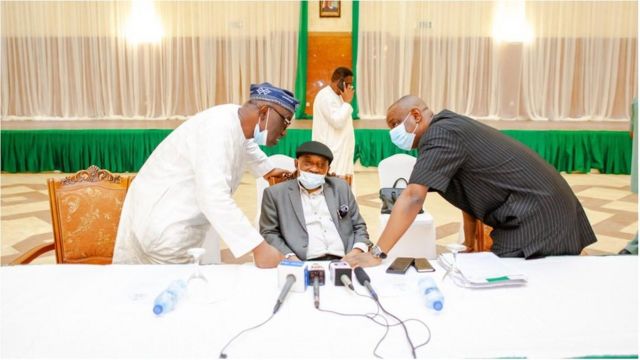
The Federal Government and Organised Labour met on Sunday to resume negotiations on the increase in electricity and petrol hikes.
The two parties had met on September 28 where the price hikes were discussed and consensus reached, leading to the inauguration of a seven-man Technical Sub-committee to review the increase in electricity tariff.
The committee which was given two weeks was expected to present its report at the Sunday meeting.
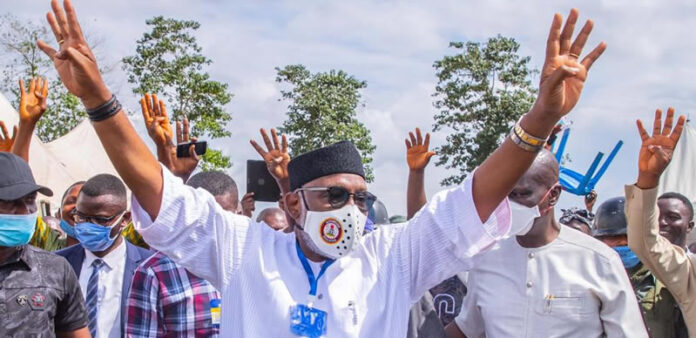
The Independent National Electoral Commission has declared Governor Rotimi Akeredolu winner of Saturday’s governorship election in the state, having polled the highest score of 292,830 votes.
Akeredolu defeated the Peoples Democratic Party candidate, Eyitayo Jegede, who got 195,791 votes, and the Deputy Governor, Agboola Ajayi, of the Zenith Labour Party, who came a distant third with 69, 127 votes.
The Ondo State Election Chief Returning Officer, and Vice-Chancellor of the University of Ibadan, Prof Idowu Olayinka, made the announcement on Sunday at the INEC headquarters in Akure.
Olayinka said, “I hereby certify that I am the returning officer of the Ondo State election and that the election was conducted and the candidates received the following votes – Oluwarotimi Akeredolu got 292,830, Eyitayo Jegede got 195,791 and Agboola Ajayi got 69,127.
“That Oluwarotimi Akeredolu secured the highest number of votes among the 17 contestants. Moreover, he was expected to score 25 per cent in two-thirds of the state but he scored it across the 18 LGAs.
“Consequently, having satisfied the requirements of the law, I hereby declare Akeredolu as the winner and he is hereby returned elected.”
Though Jegede won the first LG (Ifedore) result to be announced, Akeredolu maintained a comfortable lead after 16 of the 18 LGAs’ results were announced.
Jegede won in Akure South, Akure North, and Ifedore LGAs while the Deputy Governor and Zenith Labour Party candidate, Agboola Ajayi, won none.
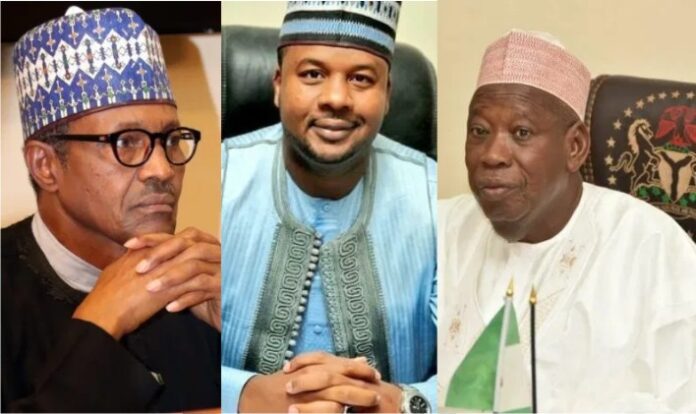
Kano State Governor, Abdullahi Ganduje, has suspended his Special Adviser on Media, Salihu Yakasai, for criticising the President, Major General Muhammadu Buhari (retd).
It was reported that Yakasai lambasted Buhari for not addressing Nigerians amid national outrage as well as days of online and offline protests against the Special Anti-Robbery Squad of the Nigeria Police Force.
Yakasai, who tweeted through his handle, @dawisu, had said the President has no empathy for Nigerians by his inaction.
The media aide wrote this shortly before the Inspector-General of Police, Mohammed Adamu, announced the disbandment of SARS in Abuja on Sunday afternoon.
Yakasai had tweeted, “I have never seen a government with zero empathy like that of President Muhammadu Buhari.
“So many times when his people are going through a difficult time and expect some sort of tap on shoulder to reassure them that he is in charge, but he failed to do so.
“The ‘I don’t care attitude’ is on another level.
“To speak to your own people over issues that are bedevilling them has become something like a favour you are doing to them.
“Over and over again, you cannot spare five minutes to address the nation to calm them down, the same people you went to the 36 states to beg for their votes, it is heartbreaking.”
Reacting in a statement, the Kano State Government described Yakasai’s comments as “unguarded utterances”, noting that his suspension was with immediate effect.
The statement was titled ‘Ganduje Suspends Media Aide Over Attack On Buhari’ and signed by the Commissioner for Information, Muhammed Garba.
The statement released on Sunday afternoon partly read, “Governor Abdullahi Umar Ganduje of Kano State has suspended his Special Adviser on Media, Salihu Tanko Yakasai over some unguarded utterances on the person of President Muhammadu Buhari on the social media platform.
“The state Commissioner for Information, Malam Muhammad Garba, who conveyed the governor’s directive in a statement this afternoon, said the suspension is with immediate effect.
“He said that though the media aide has own up the indiscreet comment as his personal opinion, but that as a public figure, it will be difficult to differentiate between personal opinion and official stand on matters of public concern.
“The governor, therefore, warned political appointees and public servants to guard against making statements capable of drawing unnecessary controversy and heating up the polity.”
Ganduje had in April sacked the state’s Commissioner for Works and Infrastructure, Mu’azu Magaji, for celebrating the death of the Chief of Staff to the President, Abba Kyari.
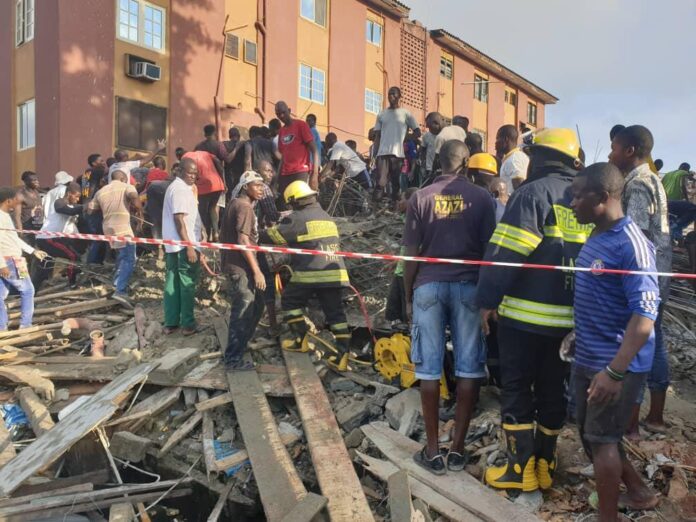
Four yet-to-be-identified persons lost their lives on Sunday when a three-storey building collapsed in the Obalende area of Lagos Island, Lagos State.
It was gathered that eight other persons were injured.
The General Manager, Lagos State Emergency Management Agency, Olufemi Oke-Osanyintolu, confirmed the incident.
He noted that the affected three-storey building located at 62, Odo Street, Obalende, Lagos Island, was under construction when it collapsed.
He said, “Upon arrival at the incident scene, a three-storey building under construction was discovered to have self-collapsed.
The cause of the collapse is yet to be ascertained, but efforts are presently ongoing by LASEMA and other responders towards salvaging the situation.
“As of 05:40pm, a total of eight people (all males) have been extricated alive by the LASEMA Response Team and other stakeholders, and have been attended and quickly transferred to the hospital by LASEMA paramedics for further medical attention at Lagos Island General Hospital.
“Four persons (three males and one female) have so far been recovered dead and handed over to SEHMU at the incident scene.”
He added that the recovery operation is still ongoing.
The Inspector-General of Police, Mohammed Adamu, has dissolved the Special Anti-Robbery Squad (SARS) of the Nigeria Police across all formations in the 36 State Police Commands and the Federal Capital Territory.
The IGP, who announced the dissolution of the unit at a press briefing on Sunday in Abuja, noted that all officers and men currently serving in the Unit are to be redeployed with immediate effect.
He said, “New policing arrangements to address the offences of armed robbery, and other violent crimes that fall within the mandate of the dissolved Special Anti-Robbery Squad shall be presented in due course.
According to him, “A Citizens and Strategic Stakeholders’ Forum will be formed to regularly interface with the leadership of the police at all levels and advice on police activities.
“To deal with the reports of crimes committed against citizens, an investigation team will be constituted which will include civil society organisations for transparency, and culprits will be punished.
“I commend the vast majority of men and women of the Nigeria Police who are diligently going about their_ duties, guided by the dictates of the rule of law, honour and professionalism. I encourage them to sustain their sense of national service, sacrifice, patriotism and commitment to crime-fighting. Their gallant efforts to ensure the safety of the lives and property of all Nigerians are very much appreciated.”
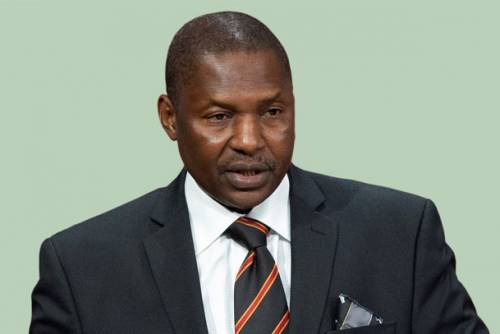
Attorney General of the Federation and Minister of Justice, Abubakar Malami (SAN)
Mr Mohammed Adoke (SAN) had barely spent five months in office as the Attorney-General of the Federation and Minister of Justice, when he, on September 20, 2010, issued the Economic and Financial Crimes Commission some regulations to assert his control over the anti-corruption agency.
By their nature, economic crimes which are part of the major focus of the EFCC are mostly connected with public offices which in turn are intertwined with politics.
This explains why the commission under successive Presidents since its establishment in 2004 has been largely seen as a political attack dog of the government in power, and this has continued to fuel speculations that anti-corruption efforts of successive governments are mere political games.
Section 43 of the EFCC (Establishment) Act which stipulates that the AGF “may make rules or regulations with respect to the exercise of any of the duties, functions or powers of the commission under this Act” provides the much needed window for the AGF to keep the anti-corruption agency under his control.
Adoke, who assumed the office of the AGF on April 6, 2010, was quick to take advantage of the provision when on September 10, 2010, he issued the 10-part regulations titled, ‘Report of Results of Investigation in Certain Cases’, mandating the EFCC to report the outcome of its investigations on “serious or complex” cases to the AGF office.
The regulations listed seven criteria that qualified cases to be “serious or complex.”
The criteria captured among others, cases having a “significant international dimension”, involving money or assets worth N50m, or “likely to be of widespread public concern.”
Such cases, according to the regulations, also included those requiring “specialised knowledge of financial, commercial, fiscal or regulatory matters such as the operation of markets, banking systems, trusts, or tax regimes.”
The rest of the criteria captured cases involving “allegations of fraudulent activity against numerous victims; substantial and significant loss of funds by a ministry, department or public body; and an alleged misconduct which amounts to an act of economic sabotage.”
With these, any major corruption case being handled by the EFCC would hardly escape categorisation as a serious or complex case that must be reported to the AGF.
Although Section 6 of the regulations stated that “nothing shall be construed as preventing the commission from exercising any of its powers under section 7 of the Act (the EFCC Act)”, many believed that the regulations denied the agency power to operate freely without the AGF’s undue interference.
Contrary to the expectations that the AGF office would loosen its grip on the EFCC under the regime of the President, Major General Muhammadu Buhari (retd), Mr Abubakar Malami (SAN), who was appointed the AGF on November 11, 2015, has only tried to exert tighter hold of his office on the commission.
He, however, did not find it easy with a heady Acting Chairman of the EFCC, Mr Ibrahim Magu.
The early signs that things had quickly gone sour between Malami and Magu surfaced when in 2017 the EFCC boss resisted repeated demands by the AGF office for various anti-corruption agencies, including the commission, to submit their lists of high-profile cases.
Magu’s resistance to Malami’s alleged invasion was believed to be due to historical distrust that the EFCC had for the AGF office.
The AGF office’s determination also manifested in the areas of some major bills pushed by Malami but perceived by the EFCC as attempts to whittle down its powers or make it vulnerable to the control of the AGF office.
The EFCC under Magu opposed the bills such as the Proceed of Crime Bill; the Nigeria Financial Intelligence Centre Bill, 2015; and the Money Laundering (Prevention and Prohibition) Bill 2016, in its bid to stave off the AGF’s control.
When Nigeria was suspended by the Egmont Group of Financial Intelligence Units in 2017, Malami, through his then Special Assistant on Media and Publicity, Salihu Isah, said the development was partly caused by EFCC’s opposition to the bills.
In the statement titled, ‘EFCC ignoble role that led to Nigeria’s Egmont suspension’, the minister recalled how the EFCC, through its opposition to the NFIC Bill, frustrated his efforts to make the National Financial Intelligence Unit independent of the EFCC as required by the global financial intelligence-gathering body.
He recalled how Magu and the EFCC allegedly frustrated his attempts to make the President to re-transmit the NIFC Bill, 2015, and the Proceeds of Crime Bill earlier passed by the 7th National Assembly for fresh consideration by the then 8th National Assembly in 2017.
The minister also recalled how the EFCC “vehemently rejected the new Money Laundering (Prevention and Prohibition) Bill 2016” during the House of Representatives Committee review session on April 18, 2017.
“They have always perceived the Office of AGF as a threat instead of addressing the issues related to the best strategy to fight corruption advocated by the AGF,” the statement read in part.
However, determined to have his way, Malami last year issued a directive gazetted as Federal Republic of Nigeria Official Gazette Vl. 106, No. 163, and titled ‘Asset Tracing, Recovery and Management Regulation 2019’, directing all anti-corruption agencies to surrender their powers of assets recovery to the Federal Ministry of Justice.
The directive, which scrapped all existing assets recovery and tracing committees, also stated that all non-conviction based forfeiture must be conducted by the AGF office.
The move was largely believed to be targeted at the EFCC being the agency with the most extensive assets recovery efforts.
Malami’s new spokesman, Dr Umar Gwandu, explained that the regulations which came under public criticism “was informed by the need to regulate the procedures for the tracing, recovery, management and disposal of illegally acquired assets as required under various extant legislation.”
Gwandu’s clarifications would hardly sway the public from seeing Malami’s moves as attempts to seize the agency’s autonomy, as less than a year later, the minister authored a memo to the President accusing Magu of abuse of office and mismanagement of recovered assets.
Acting on Malami’s memo, Buhari set up the Justice Ayo Salami-led Judicial Commission of Inquiry and ordered the suspension of Magu pending when the investigation would be concluded.
With this happening some weeks earlier, observers were quick to associate Malami with a new bill that suddenly surfaced online seeking to amend the anti-graft agency’s Establishment Act in an ambitious attempt to whittle down the powers of the EFCC and subject it to total control by the AGF office.
Malami has not confirmed or denied to be behind the bill which seeks, among others, creation of the office of a director-general to head the EFCC.
The director-general, according to the proposed law, is to be appointed by the President based on the recommendation of the AGF and subject to confirmation by the Senate.
It also seeks to eliminate the office of the Secretary of the EFCC, and also proposes that the Annual Report of the EFCC is not to be submitted to the National Assembly until it has been passed through the AGF for onward transmission to National Assembly.
The most vocal critic of the bill has been a top aide of Buhari, Prof. Itse Sagay (SAN), who is the chairman of Presidential Advisory Committee Against Corruption.
In PACAC’s statement signed by Sagay, the senior advocate described the bill as an attempt to perpetrate fraud and urged all Nigerians as well as NASS to reject it.
Sagay, who pulls no punches in repeatedly criticising Malami about his handling of anti-corruption matters, said the bill would eliminate the EFCC’s “freedom and autonomy” and replace it with “an entity under the complete control of the Minister of Justice and Attorney-General.”
He said the move to have the EFCC scrapped through the controversial bill had “become more alarming” because of the “well-known proclivity of the Attorney-General for entering nolle procequi (withdrawal of criminal cases) in favour of major political and governmental figures.”
He noted that the draft bill was being sponsored by those that were “too ashamed to put their names to the draft bill being circulated.”
He added that the bill was part of “an on-going very sinister and dangerous attempt to demolish the anti-corruption infrastructure of Nigeria and return it to the situation it was during the dark days before 2015.”
Malami has denied having any special interest in controlling the EFCC but opinions remain divided over his motive.
For the Chairman of the Civil Society Network Against Corruption, Mr Lanre Suraj, Malami’s moves to tighten his grip on the EFCC “cannot be in the public interest.”
He said, “I think it has always been historical antecedent of many of the Attorneys-General to attempt to control, and where even possible, to whittle down the power of the EFCC.
“Usually, it is about control. I think it was only under Chief Kanu Agabi (SAN), as the AGF, that the EFCC can be said to have operated without political interference from the AGF.
“It was about the control of the EFCC under Michael Aondoakaa and Bello Adoke. But Malami has taken it beyond any form of decency.”
Suraj noted that Malami had exerted similar questionable control on the Code of Conduct Bureau to the extent that the agency “is technically rendered useless.”
He alleged that Malami had not only been seeking to take over the EFCC but had been frustrating the anti-corruption war.
He said, “The EFCC, being the most vibrant organisation before now, became a target of the AGF. When it is impossible to decimate the commission as they did to the SPIP led by Okoi Obono-Obla and the commission refused to compromise, they thought that the best thing was to go all out after the chairman of the EFCC over spurious allegations.”
A lawyer and activist, Inibehe Effiong, shared similar views about Malami’s alleged penchant for terminating high-profile corruption cases, a line of thought that put a question mark on the motive behind the minister’s moves perceived as attempts by him to secure absolute control of the EFCC.
Effiong said, “Given the much touted anti-corruption mantra of the Buhari regime, one would have expected that the Attorney General will be at the forefront of fighting corruption and promoting the rule of law. Regrettably, Mr Malami from all indications, is preoccupied with sabotaging the pretentious war against corruption.
“The suspicious and questionable manner in which high-profile criminal cases instituted by the EFCC have either been taken over or discontinued by the Attorney General leaves much to be desired. It paints a terrible picture.”
He noted that instead of instituting his own cases, “Malami is going after the ones filed by the EFCC.”
He added, “This is condemnable. Unfortunately, the President is not governing. Otherwise, how do you justify the continued retention of Malami?
“He should have been fired if we had a sincere President who is truly devoted to the eradication of corruption.”
Asked to respond to the various allegations levelled against the AGF by Sagay, Suraj and Effiong, Malami’s spokesperson, Gwandu, said, “These issues have been over -flogged, time and time over again; I have no further reaction to make over the issues.”
But he also shared his previous statement in which he stated that the AGF “does not need the tinkering of the current Economic and Financial Crime (Establishment) Act 2004” for him to regulate the agency “and could therefore not, in any way, seek to sponsor any bill for more powers to control the commission.”
But a lawyer, Mr Abubakar Sani, argued that Malami could not be blamed for his alleged moves to control the EFCC.
He said, “It is understandable. It all depends on the body language of the President who appointed the AGF. If you remember, when somebody like Farida Waziri was not in the good book of the President, she had to go.
“Don’t forget that it was during the era of Aondoakaa that she was appointed, under the President Yar’adua administration.
“When President Jonathan succeeded Yar’adua, the body language changed and it was difficult for her to continue with the new AGF who was then Adoke.
“You should understand that these are human beings like you and me. As they say, whoever pays the piper calls the tune. It is very hard for the head of the EFCC to be independent, unless the President allows him.”
A Senior Advocate of Nigeria, Chief Ifedayo Adedipe, threw his weight totally behind Malami, saying the EFCC could not be allowed to operate as a loose cannon.
He stated, “I think those opposing the Honourable Attorney-General’s position are mistaken.
“The EFCC was established by an Act of the National Assembly. It is a statutory body, and beginning with the appointment of its executive chairman down the line, you cannot allow such a body, and the law does not allow such a body, to be a loose cannon without control. And that is what it (EFCC) has been in the last couple of years.”
He noted that the AGF was created by the Constitution and conferred the holder of the office with the power “to decide in the public interest, which matter to take to court and which has to be discontinued.”
“If we do not have that, what we will have is a situation in which some cases may even end up embarrassing the government,” Adedipe said.
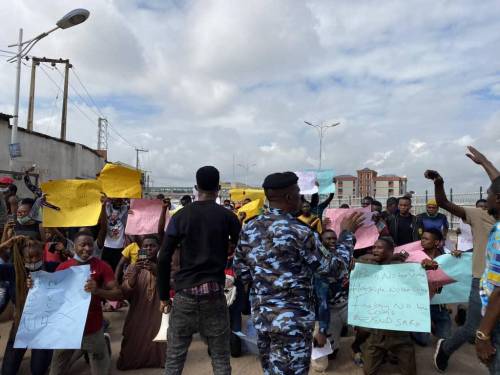
About 15 Nigerian youth were on Saturday arrested in Ogun State after men of the Special Anti-Robbery Squad unleashed violence on peaceful #EndSARS protesters.
It was gathered that those arrested were presently being detained at the state police headquarters in Eleweeran, Abeokuta, and are been denied access to lawyers.
SaharaReporters learnt that they will be arraigned on Monday in court by the police for murder.
Among those arrested are Akinbayo Damilola, Adeniyi Marcus, Akinola Ibrahim, Adele Sodiq, Ifedayo Orimolade, Aikomo Oluwatobi, Damilola Odolowu and Oladepo Olateju.
Others include Olayinka Dayo, Omogbolahan Oladayo, Adelaja Emmanuel and Olatoye Olalekan.
About five vehicles abandoned by the protesters when they were attacked by SARS officials were seized.
Also different types of phones especially iPhones were also taken away by the policemen.
One of the protesters, who spoke with SaharaReporters, accused Governor Dapo Abiodun of fabricating lies to deny the protesters their rights.
“They are at the state police headquarters now and the police wants to charge them for murder. A Toyota 2005 Camry, and a Lexus car were part of the cars the protesters abandoned and were taken away by the policemen.
“Earlier in a tweet, the Governor of Ogun State termed the peaceful protest as violent and assured that he won’t tolerate violent agitations.
“Shortly after that, a blog loyal to the Ogun State Government said the peaceful protesters ambushed the deputy governor. However, it was all fabricated lies to deny the protesters their rights.”
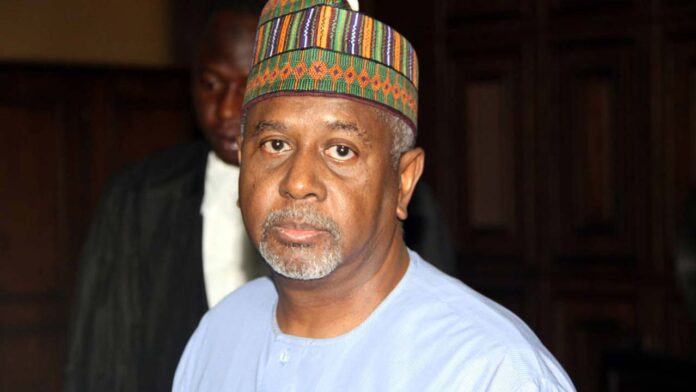
A former National Security Adviser, Col Sambo Dasuki (retd), has asked the Court of Appeal in Abuja to quash his indictment contained in the February 25, 2020 judgment of the Federal High Court in Abuja which convicted an ex-National Publicity Secretary of the Peoples Democratic Party, Olisa Metuh, on money laundering charges.
The ex-NSA urged the court not to only set aside the findings which he said were repeated about 10 times against him in the judgment, but to also set aside the entire proceedings which, according to him, were conducted in breach of established procedures.
Although not a defendant in Metuh’s trial that lasted about four years at the Federal High Court, Dasuki in his appeal, contended that his “conviction” in the judgment without being given the opportunity to defend himself was a breach of his fundamental rights to a fair hearing.
He argued in his appellant brief filed by his lead counsel, Mr Joseph Daudu (SAN), and obtained by reporters on Saturday “that the magnitude of the breach of the right to fair hearing has rendered the entirety of the proceedings worthless and non-existent, having not been tried under or through the lawful or appropriate procedure”.
“Bearing in mind the fundamental nature of the trial court’s error, especially in a criminal case, we humbly urge this honourable court not to only set aside all the findings of the trial court but to declare the entire proceedings a nullity for lack of fair hearing and jurisdiction,” Daudu stated.
Justice Okon Abang of the Federal High Court had convicted and sentenced Metuh to seven years imprisonment for money laundering involving the alleged fraudulent receipt, concealment, and unlawful use of the N400m paid to him and his firm Destra Investments Limited, by Dasuki as the NSA in November 2014.
The judge also convicted Metuh and his firm for transacting with a sum of cash of $2m without going through a financial institution as alleged in the case filed by the Economic and Financial Crimes Commission in January 2016.
Justice Abang ruled that the transfer of the N400m to Destra Investment’s bank account on November 24, 2015, was unlawfully done “in breach of public trust” by Dasuki, adding that Metuh and his firm reasonably ought to have known that the money formed part of the proceeds of the unlawful activity of the ex-NSA.
He had added that Dasuki, who is still being prosecuted for the primary offences of “breach of trust” and “corruption” at the High Court of the Federal Capital Territory in Abuja, needed not to be first convicted before Metuh and his firm could be charged with money laundering or convicted.
But in his appeal against the judgment, Dasuki’s lawyer, Daudu, stated that “there are at least 10 findings made by the trial court holding the appellant, Col Dasuki, guilty of the predicate offence, here, of corruption and criminal breach of trust”.
Daudu believed “that the denial of the right to a fair hearing on the appellant in the instant case must be condemned, and the entire proceedings of the court which culminated in the said penal findings and conclusions be set aside”.
He said the judgment “is indicative of a descent into the arena by the learned trial judge, especially as it became apparent that the learned trial judge had evinced a desire to convict the appellant (Dasuki) and the 2nd and 3rd respondents (Metuh and his firm) at all cost”.
But the EFCC, through its lawyer, Mr Sylvanus Tahir, urged the court to dismiss the appeal for lacking in merit.
He argued that Dasuki, not being a party to the trial at the Federal High Court, had no right to appeal against the judgment.
He also maintained that contrary to the ex-NSA’s claim, the judgment did not convict him.
Tahir stated, “The 1st respondent (EFCC) urges your lordship to dismiss the appellant’s appeal as lacking in merit because he was not tried, convicted and sentenced by the lower court on the offences for which the 2nd and 3rd respondents (Metuh and his firm) stood trial.
“Not having been prosecuted and convicted as an accused person, there was no denial of any right to a fair hearing of the appellant. The appellant’s appeal is purely academic and tantamount to waste of valuable judicial time”.
Meanwhile, a three-man panel of the Court of Appeal, led by Justice Stephen Adah, had on September 22, 2020 heard Dasuki’s appeal together with the separate appeals filed by Metuh and his firm.
The court reserved judgment, the date of which is to be communicated to the lawyers in the case, whenever it is ready for delivery.
Youths protesting to press home their demand to end SARS
A young man, Jimoh Isaq, has been killed by the Police in Ogbomoso, Oyo State during the #EndSARS protest.
Reports have it that an officer of the agency of state whose primary responsibility it is to defend and protect the common man from harm decided to open fire on unarmed youths voicing their dissatisfaction at the exploitation and killing of youths by the Special Anti Robbery Squad (SARS).
Jimoh Isaq was hit and died from the gunshot wound.
SARS was formed primarily to combat robbery and all forms of forceful takeaway by men of the underworld from law abiding citizens.
Recent incidents and reports (backed by pictures and videos) have shown that SARS personnel have become the very thing they were formed to combat, hence, the #EndSARS protest by Nigerian youths.
Popular Nigerian comedian in a bid to help raise awareness on mental health dressed up as a mentally challenged person and took to the streets of Lagos to test Nigerians.
This is coming as the world celebrates World Mental Health Day today.
The entertainer took to social media to share the reactions of people towards mentally ill individuals.
According to him, while some gave him money, he was chased away by some and nearly got physically assaulted by others.
He shared:
Arole dressed up as a mentally ill patient
“A lot of people are going through “Mental stress”, some people look like it, some don’t look like it. Some are mentally challenged, some are mentally ill. “Mental Health” is a state of emotional, psychological and social well being and it should be taken seriously. Celebrating the #worldmentalhealth2020 today!!!!!”
Challenging everyone to do better in the treatment of mentally ill people, he added:
“I went on the street of Lagos dressed like a “Mentally ill” person, I saw the reaction of a lot of people, some people gave me money, some ran away from me, a guy nearly slapped me, then I realized that a lot of people look down on the “Mentally challenged” in the society, which is not too good there’s more we can collectively do in love. Our psychiatrist hospitals should be looked more into by the government. Some people are not even dressed like this physically, they look good and okay but they are going through “Mental illness” which includes Clinical depression, Anxiety disorder and Bipolar disorder and a whole lots. Please let’s take our “Mental State” seriously. Celebrating #worldmentalhealth2020.”
Arole dressed up as a mentally ill person
He concluded:
If you saw a “MENTALLY iLL” person around Shoprite yesterday, stopping cars, begging for alms, begging for food. That was “WOLI AROLE”. I am the image of a lot of people “Mental State”. Some people get dressed looking nice and go to work, some people look so beautiful but are “Mentally Unstable” This was just my own way of advocating, sensitizing and creating awareness for “Mental Health”. Celebrating #worldmentalhealth2020. A man nearly hit me with his car, I ran.”