Some elder statesmen and prominent activists have said that Nigeria was on autopilot.
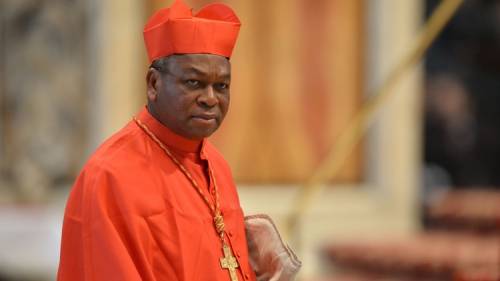
The prominent citizens, who made the assertion in a statement, include Cardinal John Onaiyekan, Dr Hakeem Baba Ahmed, Gen. Martin Luther Agwai (rtd.), Prof Attahiru Jega, Prof Jibrin Ibrahim, among several others.
Speaking under the platform of Nigeria Working Group on Peacebuilding and Governance, they called on the government to rise up to its responsibilities of running the country well.
The statement reads, “The result is that corruption has gone completely out of control, as there is a concerted effort to dismantle anti-corruption agencies and render them ineffective, while evidence of corruption is growing, prosecution has slowed down considerably.
“The civil society actors noted that in the absence of a binding narrative, there are series of conspiracy theories that have emerged, with immense capacity to divide the country along the sharp lines of ethnicity and religion, which is further sustained by the absence of strategic communication between the Nigerian state and its citizens.
“This situation is further heightening the level of desperation among the citizens that are increasingly being detached from the everyday governance of the Nigerian State.
“Indeed, the presidency has adopted the strategy of responding to demands for urgent and holistic review of the basic structures and governance processes of our nation with demeaning statements.
“This tendency to abuse those who legitimately ask those with responsibility to listen to popular voices is alienating more Nigerians from the administration and playing into the hands of those who feed off desperation.
“The nation needs to adopt a sense of urgency in the way it deals with rapidly accumulating liabilities.
“Nigerians cannot wait for the convenience or pleasure of leaders in deciding what is important.
“We must avoid the tendency to ignore our problems until they become a lot worse in terms of the capacities of leaders to deal with them.
“We call on younger Nigerians in particular, to get involved in the search for a future without current levels of bitterness and dislocations.”
Lagos State Government has declared a 24-hour curfew in every part of the state due to the ongoing #EndSARS protests.
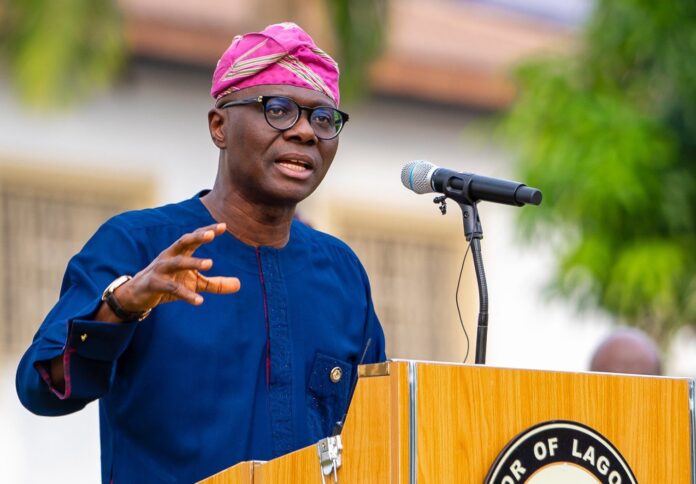
“I have watched with shock how what began as a peaceful #EndSARS protest has degenerated into a monster that is threatening the well-being of our society,” Lagos State governor, Babajide Sanwo-Olu, said in a statement.
“Lives and limbs have been lost as criminals and miscreants are now hiding under the umbrella of these protests to unleash mayhem on our state. As a government that is alive to its responsibility and has shown a commitment to the movement #ENDSARS, we will not watch and allow anarchy in our dear state.
“I, therefore, hereby impose a 24-hour curfew on all parts of the State as from 4pm today, 20th October,2020. Nobody, except essential service providers and first responders must be found on the streets.”
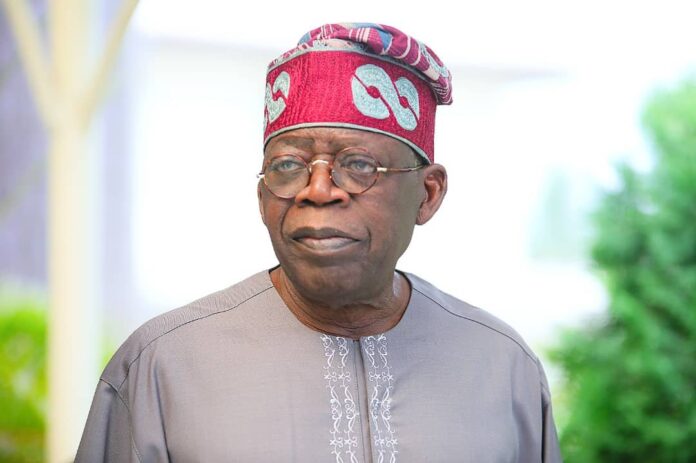
The National Leader of the All Progressives Congress, Asiwaju Bola Tinubu, has said there is no one who is committed to the rule of law and good governance that would be opposed to the ongoing #EndSARS protests by the Nigerian youths.
Tinubu, in a statement on Monday, said the protests, which had gone on for 12 days, were justified, given gross human rights violations and impunity by the now disbanded Special Anti-Robbery Squad of the Nigeria Police Force.
He also commended Nigerian youths for the level of organisation that went into the protests, saying it showed a new level of consciousness that could strengthen Nigeria’s democracy.
He said the ongoing resistance by the youths against police brutality was reminiscent of the emancipation struggle against the colonial rule and military dictatorship, which gave birth to democracy.
However, Tinubu said the protesters must admit that the regime of the President, Major General Muhammadu Buhari (retd.), had “acted with commendable dispatch by not only scrapping SARS but also accepting the five-point demand that triggered the protests.”
He said it would only be fair for the youths to call off the protests and give the regime a chance to implement the reforms they had demanded.
Tinubu’s statement on the protest, which he personally signed, was titled, ‘#EndSARS protests – The remedy for national maladies is more, not less, democracy’.
He said, “It is impossible for anyone truly committed to the rule of law, democracy and good governance to be opposed to the concern and demands of the protesters. There is no way that any society can make meaningful progress without the enthronement of these values.
“The protesters have, for the better part of the commencement of their civil action, conducted themselves with an admirable sense of responsibility, restraint and maturity. This is commendable. Indeed, the high level of organisation demonstrated by the protesting youths shows a new level of consciousness of the capability of a vigilant civil society as well as the efficacy of people’s power. This can only ultimately strengthen the country’s democratic evolution and sustainability.”
While urging the protesters to withdraw, Tinubu said Buhari had showed “a laudable sensitivity to the grievances of the youths.”
He said, “It is only fair that government must be given the chance to implement the reforms demanded by the protesters. This can certainly not be done instantaneously by the waving of a magic wand. If government had not implemented promised reforms in the past, the swiftness with which it has responded to the demands of the protesters this time around shows that that there is a positive change by government both of attitude and of a new sense of urgency.”
Tinubu urged the youths to be careful not to fritter away the considerable gains they had made within a very short period with “lack of moderation and strategic thinking”.
He said it was unfortunate that hoodlums, thugs and assorted criminals had begun to take advantage of the protests to perpetrate violence and disrupt civil life.
He said he believed the intention of the organisers of the protest was not to “cause generalised anarchy or effect regime change.”
Tinubu warned the youths that if they gave the impression that their intention was to effect a change of regime “then any government will necessarily have to act with the requisite decisiveness and force to restore law and order and preserve constitutional rule.”
However, he said the ruling APC must see the protest as “an opportunity to go back to the drawing board and recommit itself to the values for which the party was formed through extraordinary hard work, dedication and commitment.”
Meanwhile, the pan-Fulani Socio-Cultural organisation, Miyetti Allah Kailutal Hore Fulani Socio-Cultural Association, has accused Tinubu of masterminding and bankrolling the #EndSARS protest currently rocking the country.
The Fulani group claimed that the #EndSARS protest, allegedly being financed by Tinubu, was aimed at bringing down the regime of the President, Major General Muhammadu Buhari (retd.).
This, the group claimed, was because Tinubu had lost out “in the plans to contest the presidential election under the All Progressive Congress in 2023.”
The Fulani group warned that they won’t take it lightly with Tinubu should anything untoward happen to their kinsman.
They said this in a statement titled, ‘#EndSARS: Gathering of political vultures,’ in Kaduna on Monday.
The statement was signed by Miyetti Allah’s National President, Alhaji Abdullahi Bodejo, and the Secretary, Alhaji Saleh Alhasan.
According to them, the continued protest despite government’s yielding is an attempt to ground the country and create more suffering in the midst of the COVID-19 pandemic.
The group demanded that Tinubu should call off the #EndSARS protest and allow the Federal Government to fashion out modalities to address the nation’s challenges.
Alleging “ethnic and regional colouration” to the #EndSARS protests, they added, “Some people from certain regions are trying to undermine and overthrow a democratically-elected government or intimidate the North to give up its rights to rule beyond 2023.
“The insistence to continue to protest even when government has made concessions; the open defiance is reckless, provocative; denial of access to means of livelihood can lead to fracas and conflict.
“The demands of the protesters are nebulous, inconsistent, haphazard, whimsical, and impossible to meet.”
When contacted, Tinubu’s spokesman, Tunde Rahman, said, “As it has been stated elsewhere, Asiwaju Tinubu could not have sponsored the #EndSARS protest that has blocked one of the main entries into and out of Lagos and one of the economic arteries of the Lagos State Government. He could also not have sponsored such a protest where he too has been labelled a target by the organisers.”
Meanwhile, the Chairman, Caretaker/ Extra-Ordinary National Convention Planning Committee of the APC, Governor Mai Mala Buni, has alleged that there was a hidden agenda behind the nationwide #EndSARS protests.
Buni, who granted an interview with the Hausa Service of the BBC monitored in Abuja, on Monday, alleged that the refusal of the protesters to back down even after the Inspector-General of Police disbanded the Special Anti-Robbery Squad showed that they had other objectives.
He said, “When such things happen, there are those with ulterior motives. This is a nation where you have people with their own agenda.
“There are those asking for restructuring, some are secessionists, there are also criminals who see the disbanded unit as a threat to their activities. We should be careful.
“All leaders, irrespective of party affiliation, must come to their senses to realise that we must first have a peaceful Nigeria before they can attain whatever they want to achieve but if they instigate people to take to the streets for selfish reasons, it can only lead to chaos.”
Buni said Buhari didn’t realise the extent of the rot within the system until he assumed office five years ago.
Reuben Abati, former spokesperson for ex-President Goodluck Jonathan, has revealed how power slipped from his then-principal before he handed over power to his successor on May 29, 2015.
Abati noted that there was a transfer of power the minute Jonathan conceded defeat in the March 2015 general elections, saying the incident taught him about the fickleness of power.
The former Presidential media aide made this known while speaking with Chude Jideonwo on #WithChude, a television programme.
Recounting the occurrences in the aftermath of the 2015 elections, Abati said, “The first thing I noticed after that phone call that the President had conceded, is that people stopped coming to the villa to see the former President. The villa became a ghost town. The traffic to that villa just disappeared.
“We were seeing pictures of people already going to the other side, to the President-Elect, including members of the Jonathan government. They had changed camp, and the speed with which it was done was amazing.
“Around the villa, some of the people started taking excuse that they wanted to go to their village, or London for a checkup. These were people who would ordinarily not move an inch, who wanted to be in the presence of the President all the time.
“That taught me a lesson, that you’re only as relevant as the position you occupy.”
Jonathan of the Peoples Democratic Party lost the presidential election to Muhammadu Buhari of the All Progressives Congress.
Jonathan polled 12,853,162 votes and won 15 states plus the Federal Capital Territory while Buhari scored 15,424,921 votes and swept 21 states.
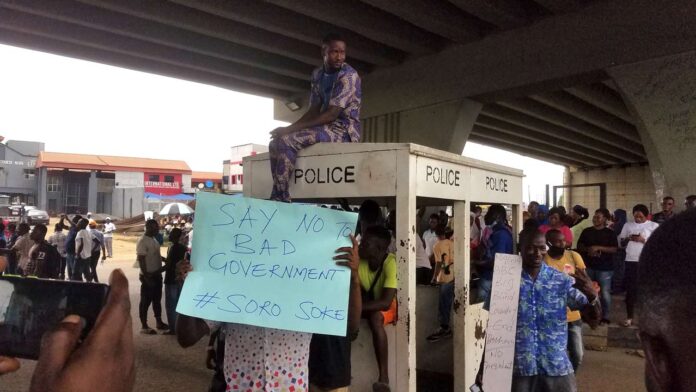
Vehicular movements was grounded in most parts of Lagos and Ogun states yesterday as the protest against the disbanded police Special Anti-Robbery Squad (SARS) unit entered its third week.
On the Lagos-Ibadan highway, the protesters carried placards with different inscriptions as they blocked the expressway on both lanes around Mowe and Arepo.
As early as 7:00a.m. the ever-busy highway was blocked forcing many commuters and motorists to return home. Some commuters were also trekking to locations where they can ride on motorcycles at exorbitant prices.
Those who were able to get bike early in the morning paid as high as N2,000 from Mowe to Berger but were stuck as they could not reach their destinations following the withdrawal of commercial vehicles from the road.
One of the commuters, Mr Edozie Johnson, who left Aseese at 4:30a.m. towards Lagos, said entering and going beyond Alausa from the expressway was hectic even before 7:30a.m. Some motorists who diverted towards FRSC-Ogba-Road were hooked in gridlock. Many commuters who decided to make a detour following the situation got stuck again as the protesters mounted a roadblock on the road.
Thousands of commuters and motorists were also stranded in different parts of Ogun State as #EndSARS protesters grounded movement and commercial activities. The protests took place in major cities of Abeokuta, Ijebu-Ode, Sagamu, Sango-Ota and Mowe.
All major entry routes into Abeokuta, the state capital, were closed against the users. In Abeokuta, the protesters laid siege at strategic locations including NNPC junction, Panseke, Ibara under bridge and Camp junction along Obantoko in the state capital.
As early as 6:00a.m. the demonstrators defied early downpour and gathered at the locations in further protest against police brutality and bad governance.
The protesters employed the services of private security guards and bouncers who manned the blockades at the various protest locations, while a handful of the operatives of the Nigerian Security and Civil Defence Corps (NSCDC) were also sighted. However, operatives of the state police command were conspicuously missing at the locations.
Addressing the protesters, a lawyer and activist, Kayode Akinsola, said the protest would continue until the government meets their demands. According to him, the youths are displeased with the way the country is being run and thereby demanding better governance.
He bemoaned insecurity, poor infrastructure and joblessness, saying: “Graduating with a first class degree does not guarantee employment in Nigeria.”
MEANWHILE, some scenes of violence were reported in the #EndSARS protest in Lagos yesterday when some hoodlums descended on some policemen attached to the Rapid Response Squad (RRS) of the Lagos State command at Adekunle police station, Yaba, around 10:00a.m.
The 97 policemen, who were being conveyed to their various beats on routine relief duties across the state, came across the hoodlums who started shouting “No police, no police”, and stoned them. After the attacks, 19 of them were critically injured while four police vehicles were damaged.
According to police spokesman, Muyiwa Adejobi, “the policemen, who scampered to safety were eventually rescued and rushed to the Police Clinic at Panti, Yaba, for medical attention.
“The Commissioner of Police Lagos state, CP Hakeem Odumosu, has condemned the attack and urged officers to remain calm while they continue to manage the situation professionally. He appealed to community leaders, parents and guardians, traditional rulers and religious leaders, to caution the youths against violence and any act that is capable of aggravating tension in the state as such would be counter-productive”.
The Premier League in England said on Monday that eight people had returned positive results in its latest round of COVID-19 tests conducted on players and staff last week.
The league said the individuals who had tested positive for the novel coronavirus would now self-isolate for 10 days.
“The Premier League can today confirm that between Monday Oct. 12 and Sunday Oct. 18, 1,575 players and club staff were tested for COVID-19. Of these, there were eight new positive tests,” the Premier League said in a statement.
A total of 42 people have tested positive for the virus in seven rounds of testing since the new campaign began on Sept. 12.
There have been more than 750,000 COVID-19 infections and over 43,000 deaths in the UK, according to a Reuters tally.
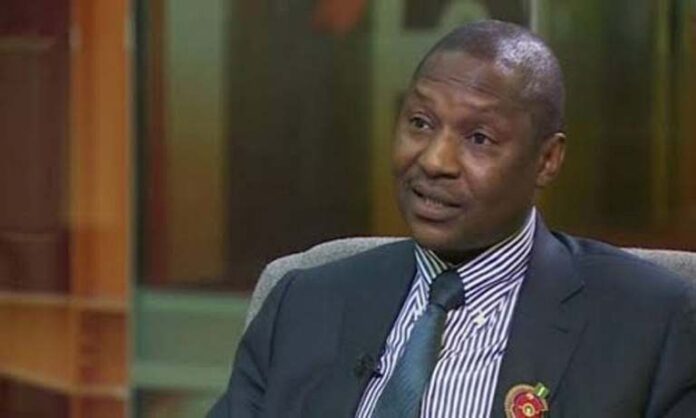
The Attorney-General of the Federation and Minister of Justice, Mr. Abubakar Malami, SAN, on Monday, received a list of 35 operatives of the disbanded Special Anti-Robbery Squad, SARS, who have been recommended for prosecution and outright dismissal from the Nigeria Police Force.
The list of the indicted SARS operatives, drawn from 12 States and the Federal Capital Territory, was handed to the AGF at the Federal Ministry of Justice Headquarters in Abuja, by a team led by the Executive Secretary of the National Human Rights Commission, NHRC, Mr. Tony Ojukwu.
The NHRC boss told newsmen that the affected SARS officers were found culpable of offences that ranged from alleged extra-judicial killings, unlawful arrest and detention, threat and intimidation, unfounded allegations, seizure of properties, as well as illegal blockage of bank accounts of innocent citizens.
Their indictment was contained in a voluminous report that was prepared by a three-man committee that was set-up to review and advise the federal government on implementation of recommendations of the Presidential Panel on Reform of SARS.
In our series of letters from African journalists, novelist and journalist Adaobi Tricia Nwaubani considers the greatest challenge facing Nigeria as Africa’s most populous nation marks 60 years of independence from the UK.
How to keep a multitude of ethnic groups united and satisfied? This was the greatest hurdle Nigeria faced in the first decade of its independence – and continues to be the case 60 years later.
Heated national conversations usually revolve around which ethnic group gets what, when, and how. Or how fairly a person from one group was treated compared to one from another.
A major policy to promote systemic equality was launched by the Nigerian government almost four decades ago, but it has led to further balkanisation and bitterness.
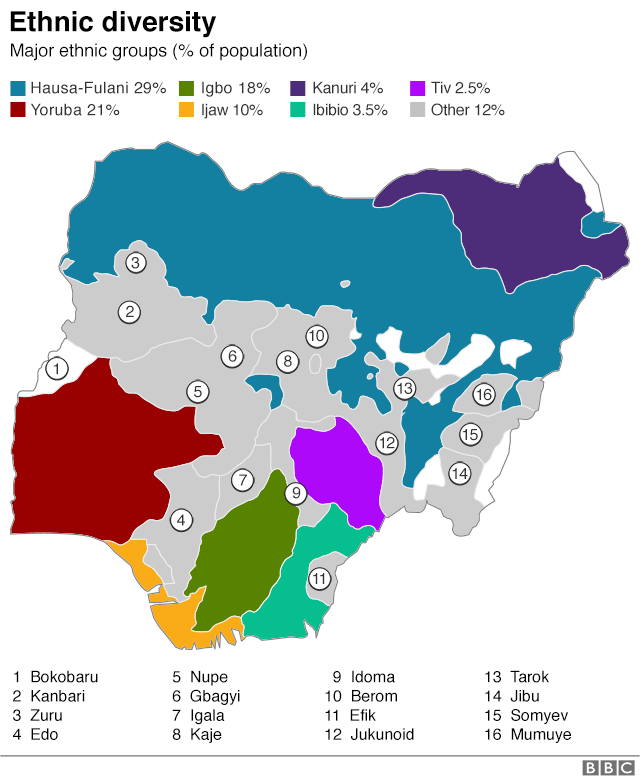
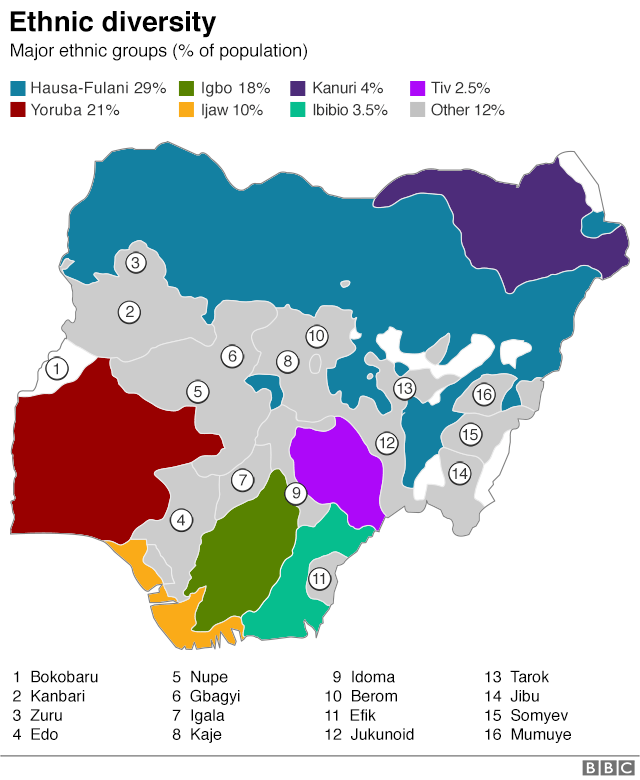
Nigeria is home to more than 300 ethnic groups and three dominant ones: the Igbo in the south-east, the Yoruba in the south-west, and the Hausa in the north.
These groups were separate entities before the British merged them into one country that today operate as a federal system – with power concentrated at the centre and distributed among the 36 states and the capital, Abuja.
Struggles for power at the centre or concerns about unfair treatment have at different times led to pogroms, protests and violent conflict, including the civil war of 1967 to 1970, sparked by an attempt by the Igbo to secede and form a new nation called Biafra.
The Biafran war explained
To foster inclusion, the “federal character principle” was enshrined in Nigeria’s 1979 constitution.
It includes a provision for public institutions to reflect the “linguistic, ethnic, religious and geographic diversity of Nigeria”.
At first, this seemed to appease all sections of the country.
Educational divide
But, today, it is one of the most contentious government policies, with many Nigerians complaining that it has done more damage to our country than good.
Local newspapers regularly feature headlines such as: “Federal Character a curse to Nigeria” or “Group calls for an end to Federal Character”.
For starters, “federal character” was not accompanied by any strategy to end the vast educational inequality that has always existed between Nigeria’s majority Muslim north and mainly Christian south.
This disparity is the result of a complex combination of factors, such as religion, culture, past colonial policies and, more recently, the Islamist militant Boko Haram insurgency.
Nigeria has 13 million out-of-school children, the highest in the world according to unicef, and more than 69% of them are in the north.
As a result, the region has Nigeria’s lowest literacy rates, with some states recording just 8%.
Yet, this same region must still fill its quota in public institutions – quite a massive chunk since it has a population of 90 million out of Nigeria’s 200 million, and 19 of 36 states, plus Abuja, totalling 20.
“Regrettably, ‘federal character’ has become a euphemism for recruiting unqualified people into the public service,” said Ike Ekweremadu, a former deputy president of Nigeria’s senate.
“These employees decrease productivity, weaken our public service, and ultimately render it inefficient.”
These unqualified can easily rise above their more qualified colleagues, as “federal character” is also applied when filling senior positions in public institutions.
In addition, rivalry between ethnic groups often leads people to lift as many of their kinsmen as they can once they find themselves in a position to do so.
Northerners have ruled the country for 38 out of Nigeria’s 60 years of independence, mostly via military coups.
I have listened to many Nigerians tell bitter stories of working hard without reward while some colleagues simply lounged their way to promotion because their kinsman was in power.
Thanks to “federal character”, ethnic solidarity and striving to be in positions of authority tend to take pre-eminence over self-improvement and excellence.
Adaobi Tricia Nwaubani
Many of Nigeria’s best brains never get the opportunity to move their country forward with their knowledge and skill ignored because there’s a large pool of talent in their state”
Almost every year, livid social media posts, newspaper columns and parliamentary debates follow the publication of cut-off marks for the exams which determine who gets into Nigeria’s top government-run secondary schools.
Students from some states in northern Nigeria sometimes require scores as low as two out of 200 to be admitted, compared to students from states in the south who need scores of at least 139.
‘Best team fielded’
Merit and excellence are often sacrificed for diversity when appointing heads of government ministries, as “federal character” also makes it mandatory for each state to have a representative in the president’s cabinet.
Many of Nigeria’s best brains never get the opportunity to move their country forward with their knowledge and skill ignored because there is a large pool of talent in their state.
Image credited to Getty Images
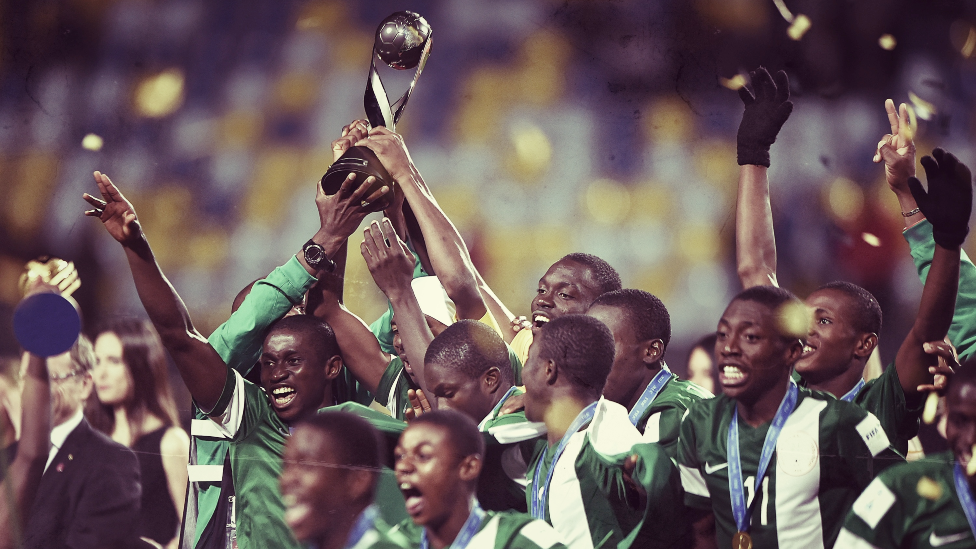
When Nigeria won the U-17 World Cup for the fifth time in 2015, critics of “federal character” were quick to point out the lack of diversity in the national team.
Nigeria simply went to the tournament with her best.
Prior to the match, the national coach, Emmanuel Amuneke, was criticised for apparently populating the team with players from his south-east region.
He was forced to explain that he had simply chosen what he considered the best, without paying attention to their place of origin.
Some Nigerians argue that “federal character” is indispensable to national unity and simply needs some tweaking to work.
Image credited to Getty Image
I believe we should have Nigerians from all over the country in public office. But all those Nigerians must be people that are competent”
Qualified people exist in every region and just need to be searched out.
After all, some of Nigeria’s globally acknowledged top brains in many fields are from the educationally disadvantaged north.
“I believe we should have Nigerians from all over the country in public office,” said Lamido Sanusi, a former central bank governor and emir of Kano in the north, who in March was deposed by his state governor under controversial circumstances.
“But all those Nigerians must be people that are competent. There must be a merit test, a competence test.”
Power politics in Nigeria:
I October 1960: Nigeria gains independence, followed by two coups in 1966
1967: Three eastern states secede, sparking three-year Biafra civil war
1979: Elections bring to power Shehu Shagari, who was ousted after four years – and a series of coups and military governments followed
1993: The military annuls elections when preliminary results show victory for Moshood Abiola
1999: Democracy returns a year after the death of military ruler Gen Sani Abacha
2015: Muhammadu Buhari becomes first opposition figure to win a presidential election since 1960
Nigeria’s Timeline
President Muhammadu Buhari has been frequently vilified even by opponents of “federal character”, for appearing to abandon this policy.
“I don’t have a problem with any part of Nigeria but I have a problem with the way government is directing its appointments,” said Mr Ekweremadu during a fiery session in parliament in 2018.
At present, 17 out of Nigeria’s 20 service chiefs appointed by Mr Buhari are from his northern region, while 16 are Muslim like him.
And 15 out of 21 serving assistant inspectors general of police are from the north, while 16 are Muslim.
In defence of his boss, presidential spokesperson Garba Shehu told me: “Are you going to give your command positions in the military to people you don’t trust?”
Image Credited to Getty Images
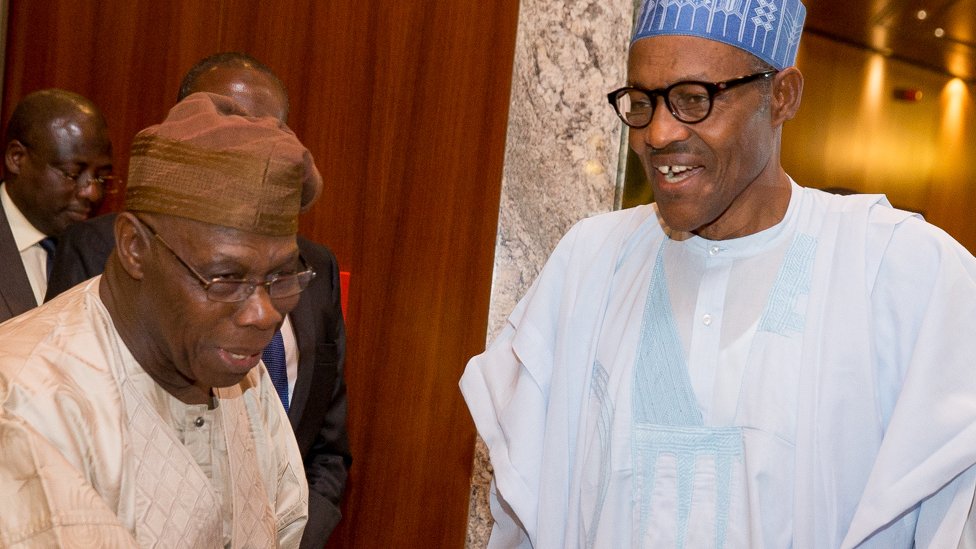
Ex-President Obsanjo (L) from the south-west and President Buhari (R) from the north have both been accused of favouring their regions
Former President Olusegun Obasanjo, once a supporter of Mr Buhari, recently accused him of “mismanaging diversity” and being responsible for a Nigeria that is today more divided than at any previous time in the country’s history.
Nobel laureate and writer Wole Soyinka shared a similar view last month, making reference to “a culture of sectarian privilege and will to dominate”.
However, Mr Buhari’s spokesperson pointed out that previous administrations also faced the same accusation.
“When you are not on seat [in office], you always see the wrongdoing of others,” Mr Shehu said.
“When Obasanjo was in position, he was also accused of appointing people from the south-west.”
Some radical groups in the south now believe that the only solution is for Nigeria to split, with each major ethnic region becoming a country of its own.
Some politicians and pundits prefer “restructuring” with each region having more autonomy, which would keep Nigeria united but significantly reduce power at the centre.
Whatever resolution Nigeria eventually takes as it enters its 70th decade of independence, one thing is certain: the country’s future depends on how successfully coming governments can maintain unity in diversity.